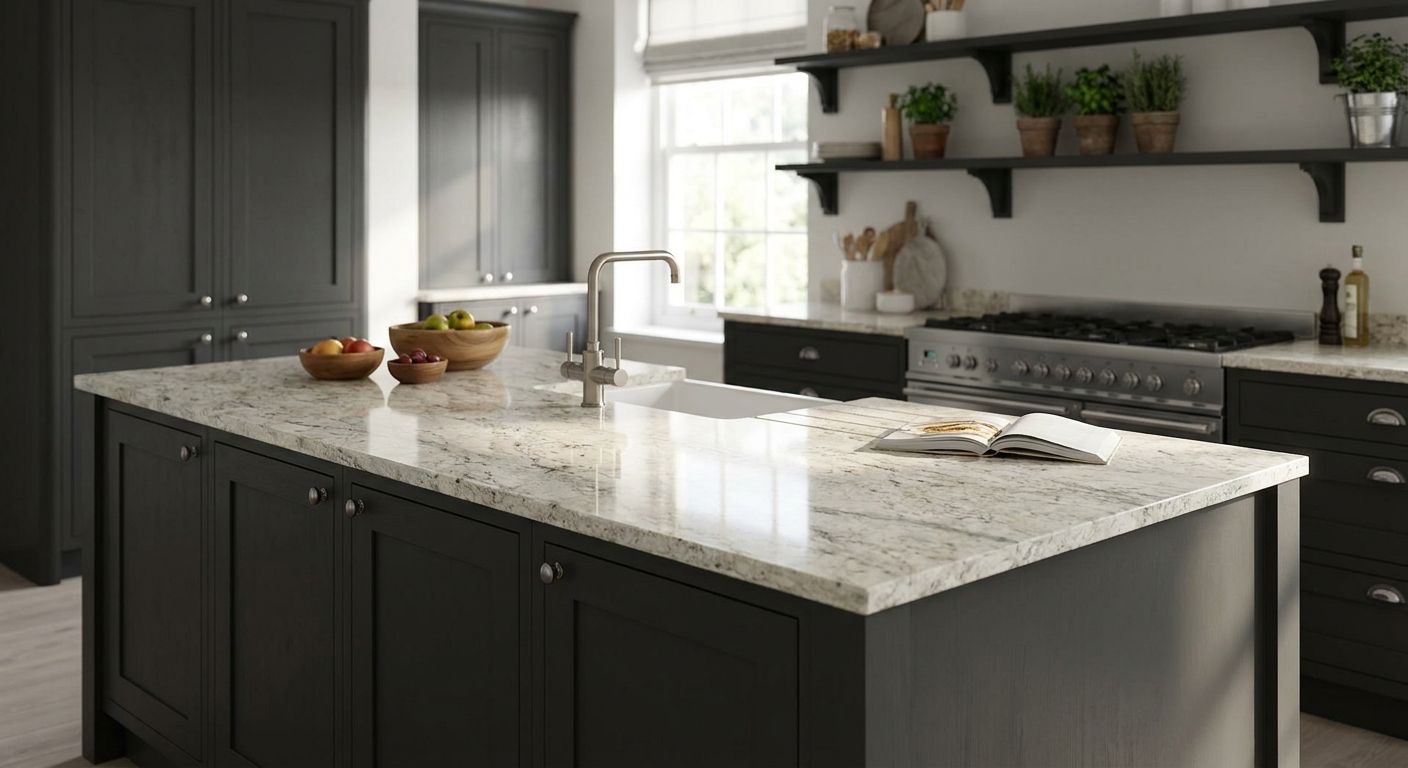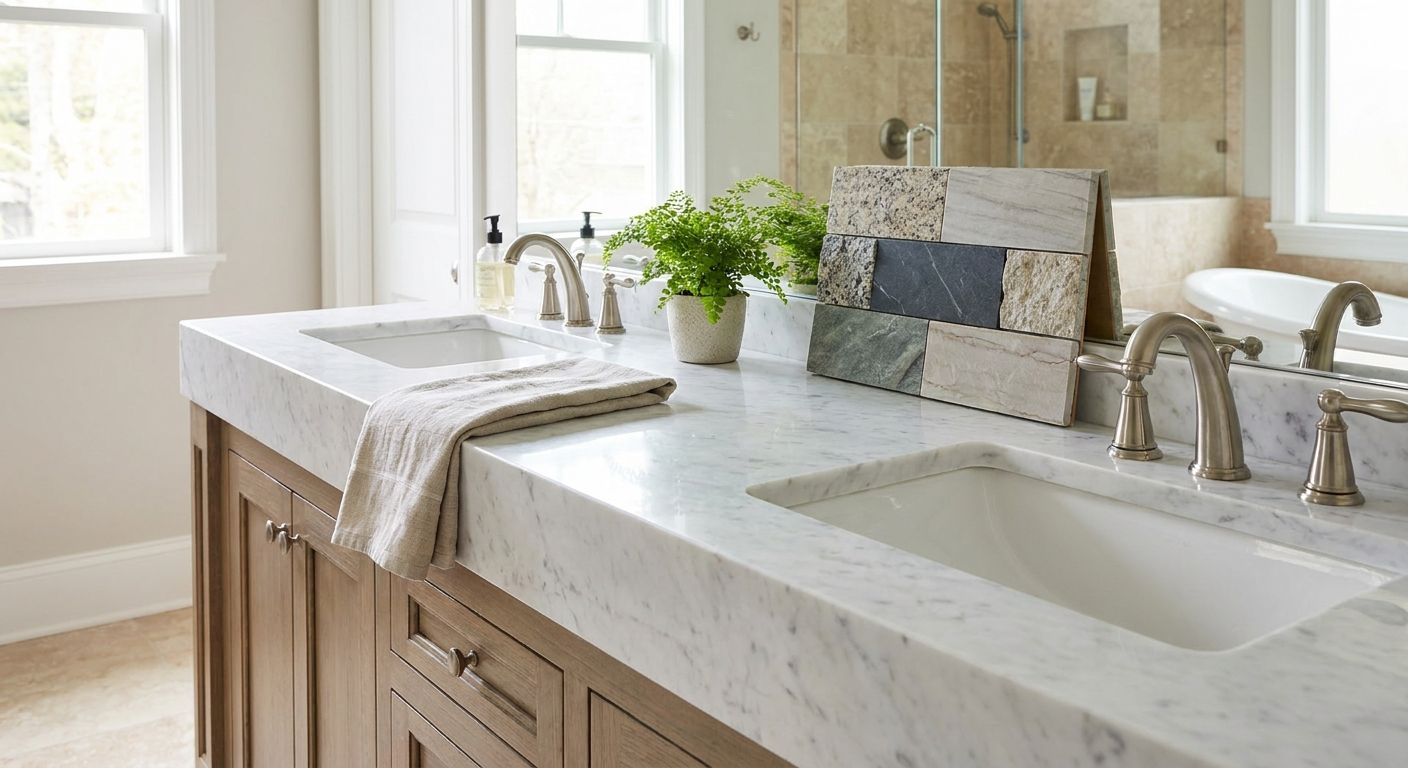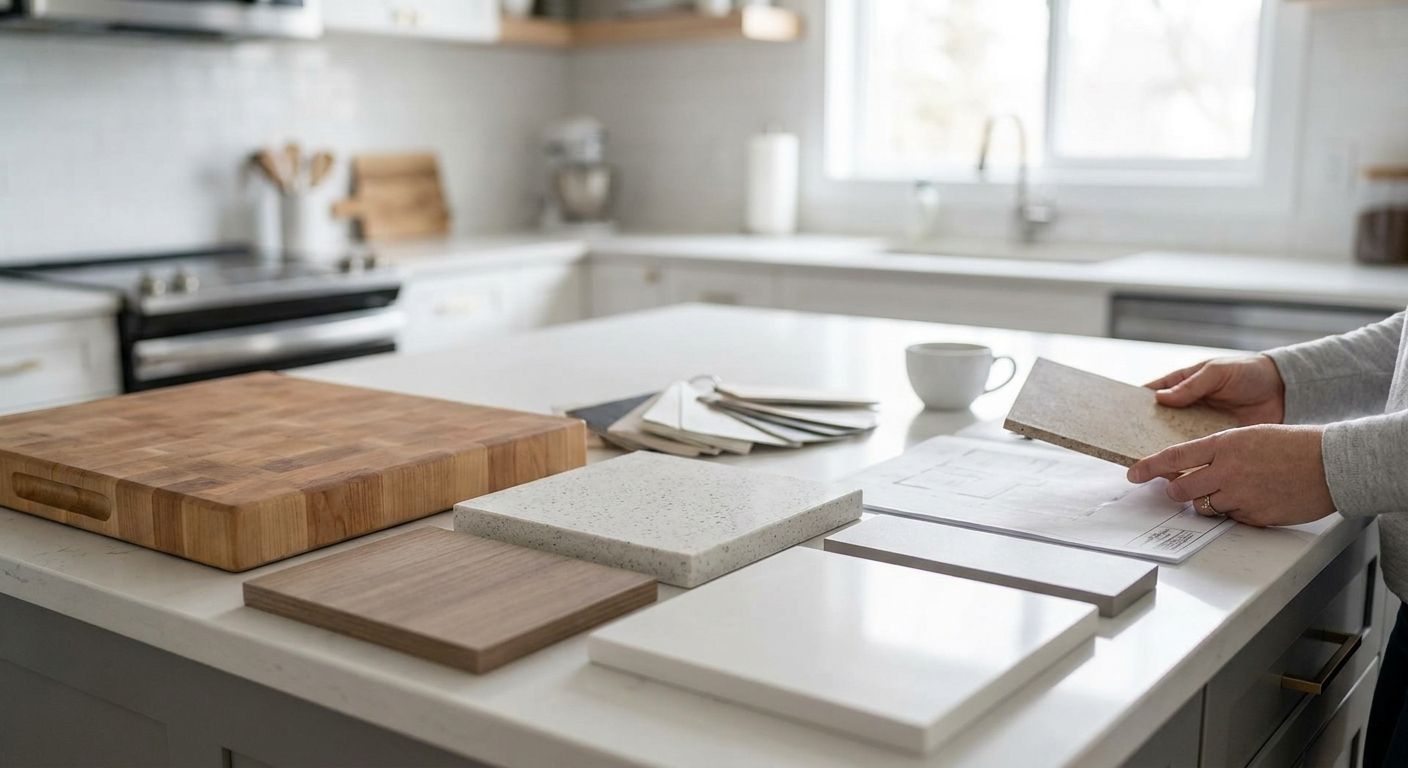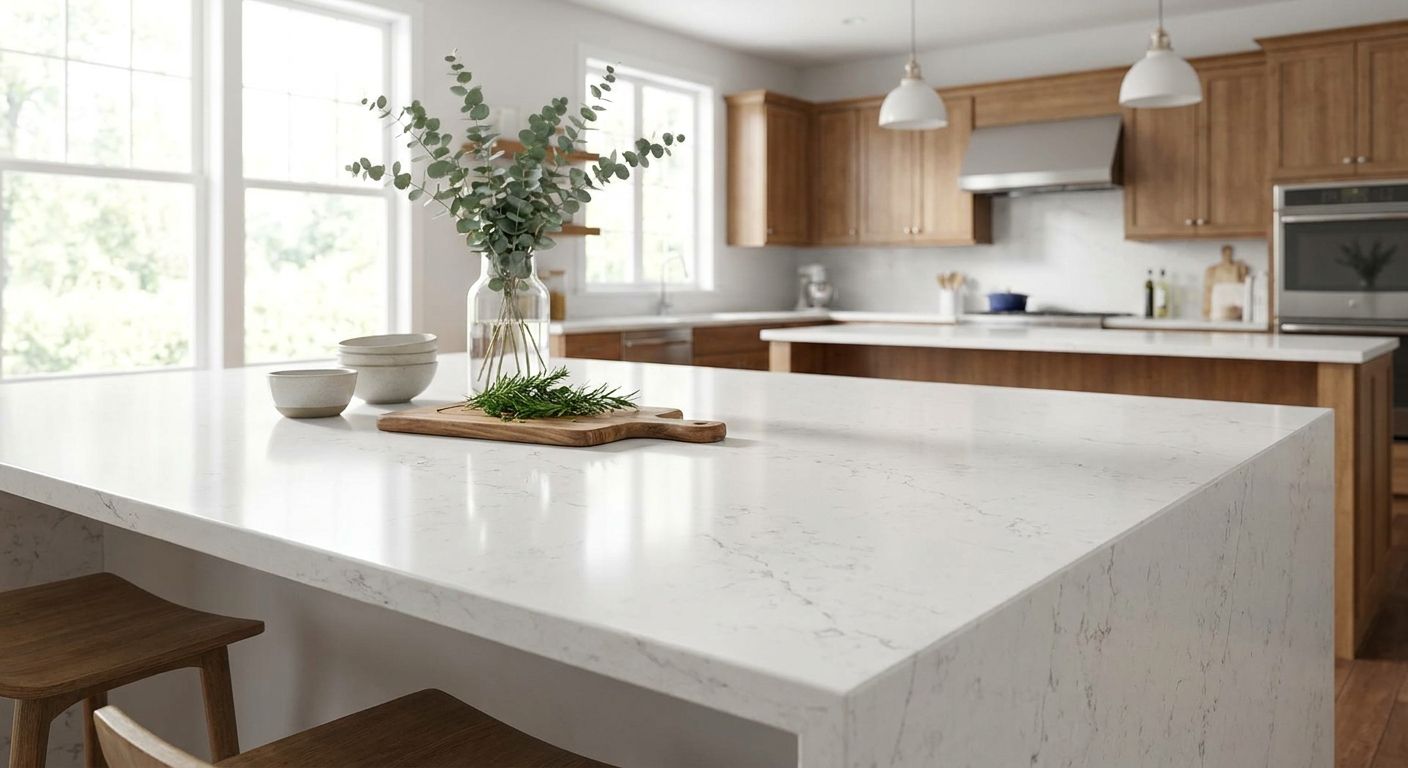
If you're planning a kitchen island resurface or a new build in 2026, quartz countertops for kitchen islands solve the two problems that sink most island projects: seam visibility and daily wear from stools, spills, and constant prep work.
- Quartz countertops for kitchen islands hold up better than granite against daily stool traffic and prep spills — Buy for busy kitchens.
- Solid or near-solid quartz colors hide seams best on islands over 8 feet long.
- Waterfall-edge quartz islands need a full slab commitment, not a cut-and-patch job — budget for it upfront.
- Standard quartz is not rated for outdoor islands exposed to direct sun; quartzite is the correct swap there.
Why this matters
An island isn't a countertop against a wall — it's viewed from every angle, touched by every family member, and usually doubles as the seating area. That changes what actually matters when you're choosing quartz countertops for kitchen islands versus quartz for a perimeter run against a backsplash.
Granite countertops for kitchen islands are still a solid option for buyers who want unique natural veining, but granite needs periodic sealing and shows etching from acidic spills faster than quartz does. Quartz's engineered, non-porous surface is why it dominates island installs in New England kitchens heading into 2026.
Who this is for
This guide is for homeowners planning a kitchen island — new build or remodel — who want a surface that survives kids doing homework, guests leaning on stools, and daily meal prep without babying it. If your island sees more traffic than your perimeter counters, this is the decision that matters most in your kitchen plan.
What to look for in quartz countertops for kitchen islands
Slab thickness and overhang support
Most fabricators run 3cm quartz for islands because it handles unsupported overhangs better than 2cm material. Anything past 10 to 14 inches of overhang typically needs steel or plywood corbels underneath — skip this detail and you risk cracking at the overhang edge within the first year of stool use.
Edge profile and waterfall potential
Islands are the one place in the kitchen where a waterfall edge (quartz that wraps down the side to the floor) actually makes sense, because it's viewed in the round. Waterfall edges need a full matching slab, not offcuts, so factor that into layout planning before you fall in love with a pattern.
Heat and stain resistance at the prep zone
Quartz resists staining from wine, oil, and citrus better than granite or marble because the resin binder seals the surface completely — no sealing required, ever. It's still not heatproof: the resin can scorch or discolor above roughly 150°F of direct, sustained contact, so trivets still matter near the island's prep zone.
Pattern movement and seam placement
On an island longer than 8 feet, you're almost always looking at one seam somewhere in the slab. Bold veined patterns (Calacatta-style quartz) make that seam obvious if the fabricator doesn't book-match the veining; solid or subtly speckled quartz hides seams almost completely.
Finish — polished versus honed
Polished quartz reflects light and reads brighter, which works for islands that anchor a bright, open kitchen. Honed (matte) quartz hides fingerprints and water spots better on a surface that gets touched constantly, which is exactly what an island is.
Color consistency across the whole island
Because quartz is engineered, color batches can vary slightly between production runs. Order all slabs for one island from the same lot number — a mismatched island top is one of the most common complaints in quartz installs, and it's entirely avoidable at the ordering stage.
Top picks for kitchen islands
Solid white or off-white quartz — the safe pick. Near-solid colors carry a Mohs hardness of 7 and hide seams almost invisibly on islands over 8 feet. It reads clean against almost any cabinet color and won't look dated in five years. Buy.
Calacatta-style veined quartz — the statement pick. Large-format slabs, some running up to roughly 126 by 63 inches, cut down on seams even with dramatic veining. It's the pick for an island meant to be the visual anchor of the kitchen, but expect a higher price than solid colors. Consider.
Waterfall-edge quartz — the wildcard. Wrapping the slab down both ends of the island turns it into a piece of furniture, not just a counter. It requires committing to a full slab per waterfall side and adds fabrication and install time — this is not a budget add-on. Consider.
Dark charcoal or black quartz — the low-maintenance pick. Darker quartz hides fingerprints, water rings, and daily wear at the prep zone better than any lighter color. It pairs well with white or light cabinetry for contrast and holds up visually in high-traffic kitchens. Buy.
Leathered or textured-finish quartz — the trend pick. The textured surface adds tactile interest but shows fingerprints and grease more than a polished or honed finish. Good for a display island that isn't the primary eating surface; skip it for a stool-height island where hands are on it constantly. Skip for eating islands.
If you're still torn between quartz and natural stone for the island specifically, the breakdown in how to choose between quartz and quartzite countertops covers the hardness and heat-resistance tradeoffs in more depth, and it applies just as well when granite is the other option on the table — see granite countertops for kitchen islands if natural veining is still in the running.
Get your island measured and quoted
Free in-home estimate for quartz island countertops in 2026.
What to avoid
- Standard quartz on an outdoor or three-season island. UV exposure yellows the resin binder over time — if the island sits under open sky or a screened porch, quartzite countertops for outdoor kitchens is the correct material, not quartz.
- 2cm slabs on a long overhang without bracket support. It looks fine on the showroom sample and cracks at the overhang edge within a year of stool use.
- Mixing slab lots for one island. Even a half-shade difference between two pieces of the same quartz color is visible once installed under kitchen lighting.
Verdict comparison
| Pick | Best for | Seam visibility | Verdict |
|---|---|---|---|
| Solid white/off-white quartz | Everyday islands, resale-focused kitchens | Nearly invisible | Buy |
| Calacatta-style veined quartz | Statement islands, open-concept kitchens | Visible unless book-matched | Consider |
| Waterfall-edge quartz | Furniture-style islands | Minimal (single slab per side) | Consider |
| Dark charcoal/black quartz | High-traffic, low-maintenance islands | Nearly invisible | Buy |
| Leathered/textured quartz | Display islands, not eating surfaces | Moderate | Skip for eating islands |
FAQ
What's the best quartz color for a kitchen island in 2026?
Solid white, off-white, and dark charcoal quartz are the most reliable picks for kitchen islands in 2026 because they hide seams and daily wear better than heavily veined patterns. Bold veined quartz still works if the fabricator book-matches the pattern across any seam.
Is quartz better than granite for kitchen islands?
Quartz resists staining and never needs sealing, which makes it lower-maintenance than granite for a high-traffic island. Granite still wins for buyers who want one-of-a-kind natural veining and don't mind occasional resealing.
How much overhang can quartz support without brackets?
Quartz typically supports 10 to 14 inches of unsupported overhang before it needs steel or plywood bracket support underneath. Beyond that range, unsupported quartz risks cracking under stool weight.
Can you put a hot pan directly on quartz countertops?
No, quartz can scorch or discolor from sustained direct heat above roughly 150°F because of its resin binder. Always use a trivet near the island's prep zone even though quartz resists stains and scratches well.
How thick should quartz be for a kitchen island?
3cm quartz is the standard thickness for kitchen islands because it handles overhangs and edge profiles like waterfall edges better than thinner 2cm material. 2cm slabs are more common on perimeter counters backed by cabinetry.
Does quartz need sealing like granite or marble?
No, quartz is non-porous because of its resin binder, so it never needs sealing. That's one of the main reasons quartz countertops for kitchen islands outsell natural stone for high-traffic island tops.
Can quartz have a waterfall edge?
Yes, quartz supports waterfall edges, but each waterfall side requires a full matching slab rather than an offcut. Plan for the added slab and fabrication cost before finalizing an island layout with a waterfall edge.
Is quartz suitable for a small kitchen island?
Yes, quartz works well on small islands and is often easier to keep seamless on a shorter run than on an island over 8 feet. Smaller islands also make bold veined patterns more affordable since less slab is needed.
One last thing
The detail most homeowners skip is ordering samples at full size, not the 4-inch chip from the showroom — quartz color and veining read completely differently across a 9-foot island than they do on a swatch, and that mismatch is the number one source of buyer's remorse on island installs going into 2026.