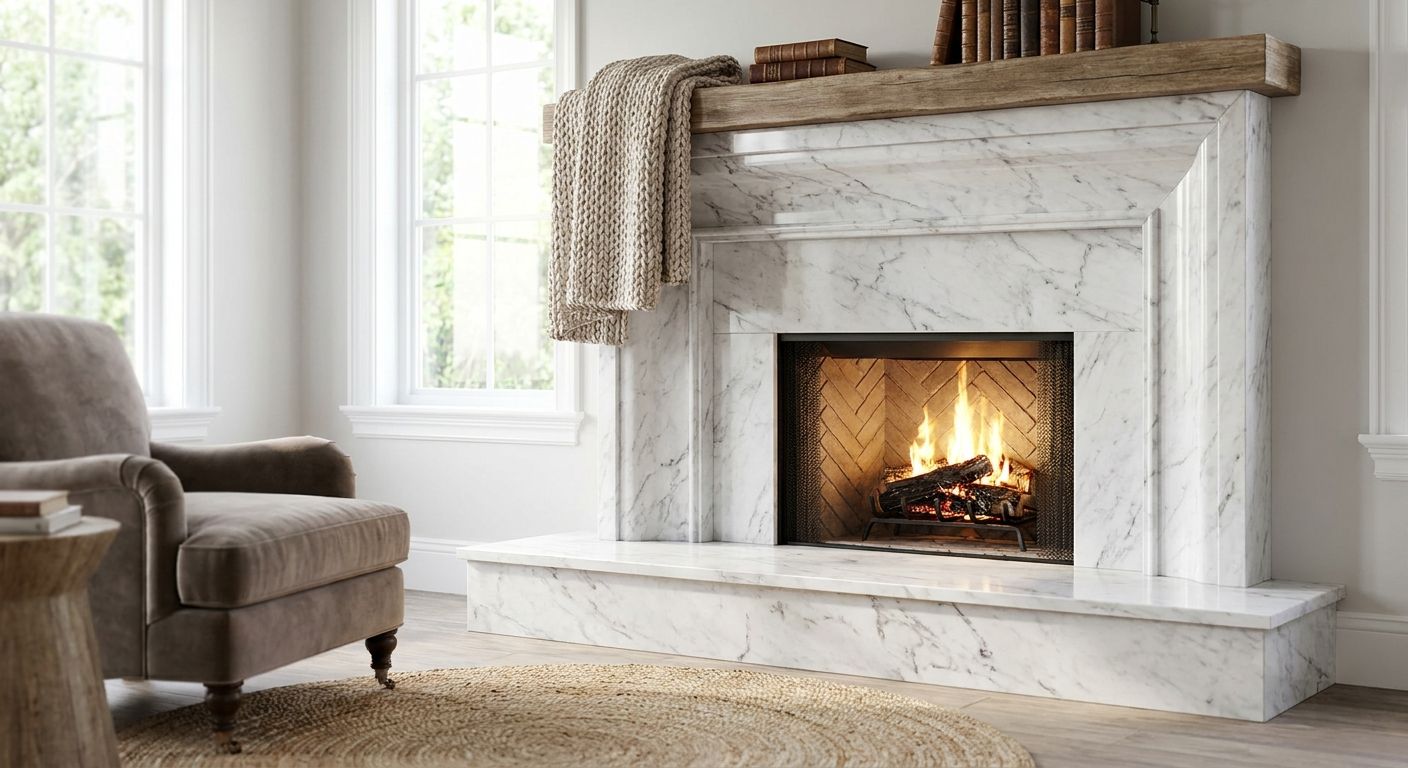
A marble surround turns a fireplace into the room's anchor, but marble's softness and porosity make it a different animal than the granite or quartz on your kitchen island. This guide breaks down what actually holds up next to heat and soot, and what looks good in the showroom but fails within a year.
- Carrara marble is the safe buy for marble surrounds for fireplace hearths in 2026 — durable, classic, roughly $50-80 per square foot installed.
- Vermont Danby marble is the local pick for New England homes and matches regional stone character.
- Skip cultured or engineered marble near an open flame — it's resin-bound and can discolor under sustained heat.
- Honed finish hides soot smudges better than polished marble on daily-use hearths.
- Minimum 3/4-inch slab thickness is non-negotiable for any surround within 6 inches of a firebox opening.
Why this matters
Most homeowners pick a marble surround off a photo, then find out later that the slab they loved stains from soot or cracks near the firebox opening. A fireplace surround sees more direct heat exposure than any other stone surface in a house, which changes the calculus completely compared to picking a kitchen counter.
Soares Stone has fabricated surrounds for wood-burning, gas, and electric fireplaces across New England, and the pattern is consistent: the surrounds that last are chosen on thickness, porosity, and finish first, and color second. Get those three right and the marble will outlast the mantel around it.
Who this is for
This guide is for homeowners renovating a fireplace hearth — whether you're replacing a dated tile surround, finishing a new build, or upgrading a builder-grade mantel before a resale. It applies whether your fireplace is wood-burning, gas insert, or electric, since heat exposure and cleaning habits differ across all three. If you're comparing marble against granite or quartzite for the same hearth, the criteria below still apply, just weigh porosity and heat tolerance more heavily for marble.
What to look for in marble surrounds for fireplace hearths
Heat tolerance and slab thickness
Marble handles radiant heat fine, but thin slabs near an open flame are a real risk. Anything under 3/4-inch thickness within 6 inches of a firebox opening is a skip — thermal stress can crack thin marble over repeated heating and cooling cycles. Standard 3cm (1.18-inch) slabs give you margin for a wood-burning fireplace that runs hot all winter.
Porosity and sealing near soot
Marble is calcium carbonate, which means it's more porous than granite or quartzite and absorbs soot and smoke residue if left unsealed. A penetrating sealer applied at install and reapplied annually keeps a marble surround from yellowing over a few burning seasons. Skip this step and you'll see grey staining creep into the stone within 12 to 18 months.
Finish: polished versus honed
Polished marble shows every fingerprint and soot smudge under direct light, which is a problem on a surface people touch constantly near a mantel. Honed marble has a matte, low-sheen finish that hides daily grime far better and still reads as elegant in a living room. For daily-use hearths, honed wins; for a formal room used a few times a year, polished still works.
Vein pattern matched to room scale
Bold veining like Calacatta reads dramatic on a large surround with a wide mantel, but the same pattern on a narrow hearth can look busy and cut-off. Measure your surround width before falling in love with a slab photo — veining direction matters more on a vertical surround than it does on a horizontal countertop.
Local sourcing and slab availability
New England fabricators have faster access to certain marbles than others, and lead time affects your renovation timeline directly. Vermont-quarried marble ships shorter distances and often has quicker turnaround than imported Italian slabs, which can run 4-6 weeks out depending on the quarry.
Cost relative to granite and quartzite
Marble surrounds typically run $50 to $180 per square foot installed in 2026 depending on the variety, while granite and quartzite alternatives for the same application often land 15-25% lower. If budget is the deciding factor, this is the point where it's worth comparing how quartz and quartzite countertops stack up against marble for heat resistance and upkeep — quartzite in particular handles heat better than marble with less sealing maintenance.
Get a fireplace surround quote
See marble, granite, and quartzite options priced for your hearth.
Top picks for marble fireplace surrounds
Carrara marble — the safe pick. White-to-grey background with soft, linear veining, running roughly $50-80 per square foot installed in 2026. It's the most widely available marble in North America, which keeps both cost and lead time predictable. Verdict: Buy.
Vermont Danby marble — the local pick. Quarried in Vermont, this white marble with subtle grey veining matches the New England aesthetic and typically ships faster than imported stone. It's a strong choice if you want a regional story behind the material. Verdict: Buy.
Calacatta marble — the showstopper. Bolder, thicker veining on a brighter white background, priced around $100-180 per square foot installed. It photographs beautifully but shows soot and fingerprints faster than Carrara if left polished. Verdict: Consider, and pair it with a honed finish for daily-use fireplaces.
Emperador marble — the wildcard. A warm brown marble with darker veining that hides soot better than white marbles by nature of its color. It reads more traditional and works well with dark wood mantels, but availability is thinner in New England than white marbles. Verdict: Consider.
Cultured or engineered marble — the imposter. Resin-bound composite marketed as marble but chemically different, with lower heat tolerance than natural stone. Sustained heat exposure near a firebox can discolor or warp the resin binder over a few seasons. Verdict: Skip for any surround within a few feet of an active flame.
What to avoid
- Thin veneer marble tiles under 1/2 inch near the firebox opening — they crack under thermal cycling faster than solid slab.
- Unsealed polished marble on a wood-burning fireplace — soot penetrates the porous surface within one heating season without a sealer.
- Cultured marble marketed as a budget alternative — it's not rated for the same heat exposure as quarried stone, despite similar looks.
Comparison at a glance
| Marble type | Cost installed (2026) | Heat tolerance | Best finish | Verdict |
|---|---|---|---|---|
| Carrara | $50-80/sqft | Good with sealing | Honed or polished | Buy |
| Vermont Danby | $55-85/sqft | Good with sealing | Honed | Buy |
| Calacatta | $100-180/sqft | Good with sealing | Honed | Consider |
| Emperador | $70-110/sqft | Good with sealing | Polished | Consider |
| Cultured marble | $30-50/sqft | Poor near open flame | N/A | Skip |
“Honed marble hides soot smudges that polished marble can't.”
FAQ
What's the best marble for a fireplace surround?
Carrara marble is the best all-around choice for most fireplace surrounds in 2026, priced around $50-80 per square foot installed with wide slab availability. Vermont Danby marble is a strong regional alternative for New England homes.
Is marble safe to use around an open flame?
Natural marble handles radiant heat well as long as the slab is at least 3/4 inch thick and sealed against soot absorption. Thin veneer tiles or cultured marble composites are not rated for the same heat exposure.
How much does a marble fireplace surround cost?
A marble fireplace surround typically costs $50 to $180 per square foot installed in 2026, depending on the marble variety and slab thickness. Carrara sits at the lower end; Calacatta runs highest due to bolder veining and higher demand.
Is quartzite better than marble for a fireplace surround?
Quartzite handles heat with less sealing maintenance than marble and resists staining better, making it a strong alternative if low upkeep matters more than the classic marble look. Marble still wins on the softer, more traditional veining most buyers want for a mantel.
Do marble fireplace surrounds need sealing?
Yes, marble surrounds need a penetrating sealer applied at installation and reapplied roughly once a year to prevent soot and smoke staining. Skipping sealing on a wood-burning fireplace often shows grey staining within 12 to 18 months.
Should I choose polished or honed marble for a hearth?
Honed marble is the better choice for daily-use hearths because its matte finish hides soot smudges and fingerprints better than polished marble. Polished marble still works for fireplaces used only occasionally in formal rooms.
How thick should marble be for a fireplace surround?
Marble near a firebox opening should be at least 3/4 inch thick, with standard 3cm slabs preferred for wood-burning fireplaces that run hot through winter. Thinner slabs are more prone to cracking from repeated heating and cooling cycles.
Can I use cultured marble on a fireplace surround?
Cultured marble is not recommended within a few feet of an active flame because its resin binder has lower heat tolerance than natural stone. It's a skip for any surround with direct heat exposure, even though it costs less upfront.
One last thing
Most homeowners assume polished marble is the premium choice, but for a hearth in daily use, honed marble is the better-performing finish — it hides soot and handles years of hand contact near the mantel without showing every smudge. If you're weighing marble against a more heat-forgiving alternative, ask about quartzite before committing to a slab.