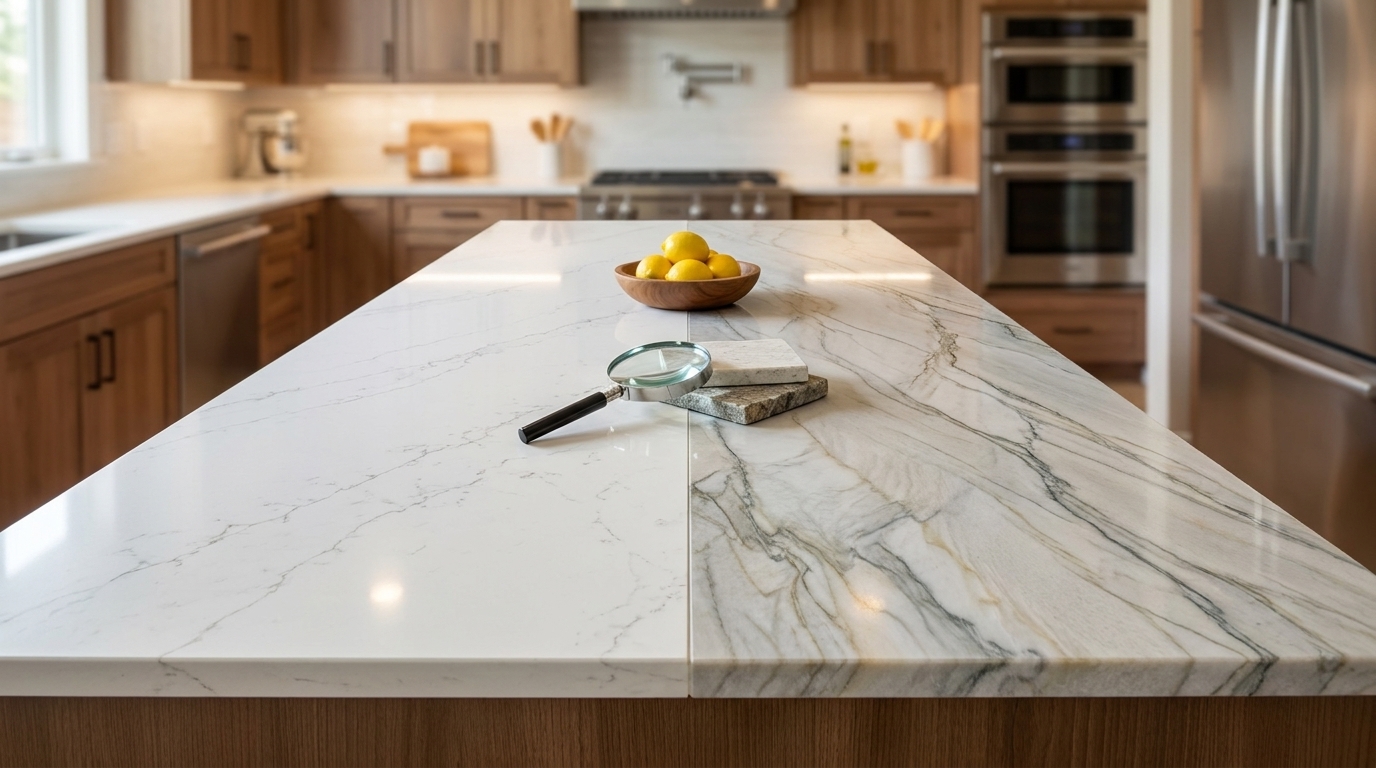
Quartz and quartzite look almost identical on a showroom sample and behave nothing alike in a working kitchen. Picking wrong means living with etch marks, chips, or a maintenance routine you didn't sign up for — this guide walks through the exact decision points before you order slabs.
- Quartz wins for busy households: nonporous, no sealing, and consistent patterning across the whole kitchen. Buy it if low maintenance matters most.
- Quartzite wins for heat-heavy cooktops and natural stone character, but needs annual sealing. Buy it if you accept upkeep for authenticity.
- Both run in similar price territory in 2026, so budget rarely decides the quartz vs quartzite countertops question — usage does.
- Quartz can discolor under prolonged direct sun; quartzite handles UV and heat without fading.
- A local fabricator like Soares Stone should template your kitchen before you commit to either material — slab variation changes the math.
Why this matters
Quartz is engineered — roughly 90-95% ground quartz mixed with resins and pigment — so every slab from the same lot looks nearly identical. Quartzite is 100% natural stone, quarried and cut, so no two slabs match perfectly even from the same block.
That single difference drives almost every decision in this guide: maintenance, heat tolerance, appearance consistency, and how your kitchen will look in 2036, not just in 2026. Soares Stone fabricates both materials for New England kitchens and sees the same failure pattern repeatedly: homeowners choose based on a photo, not on how they actually cook.
Get the usage pattern right first. The material choice follows.
What you'll need
- A tape measure and rough square footage of your countertop run
- Photos of your current cooktop placement relative to counter edges
- A sense of your cleaning habits — daily wipe-down vs. weekly deep clean
- A budget range per square foot, installed
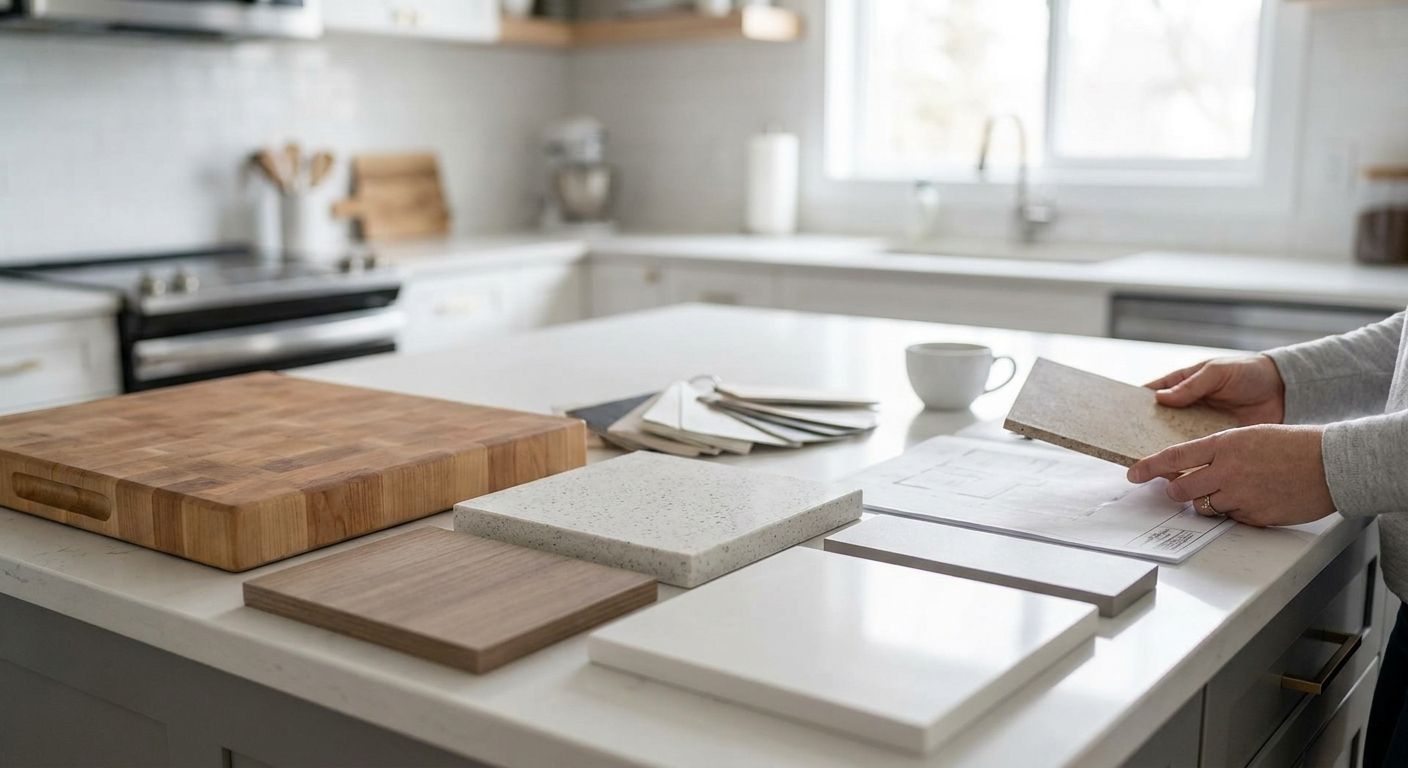
- Access to full slab samples, not 2×2 inch chips (patterning only shows at scale)
- A fabricator visit for templating before final material lock-in
The steps
1. Audit your daily kitchen habits
This decides more than any spec sheet. If you cook with acidic ingredients daily — citrus, wine, tomato sauce — and you're not going to wipe spills within minutes, quartz's nonporous surface protects you from etching in a way quartzite cannot.
Quartzite is a natural stone with calcite content in many varieties, and calcite etches on contact with acid. A lemon left on a quartzite counter for twenty minutes can leave a dull ring that no amount of scrubbing removes. Quartz doesn't etch because there's no calcite in the resin-bound surface.
Common mistake: assuming all quartzite behaves like granite. Some quartzite varieties (true quartzite, not marble sold as quartzite) resist etching better, but you need lab or fabricator verification, not a showroom label.
2. Set your budget per square foot
Installed pricing for both materials in 2026 typically overlaps in the mid-to-high range, with premium quartzite slabs and premium quartz lines both pushing costs up. Don't assume quartz is automatically cheaper — high-end quartz brands can cost more than mid-tier quartzite.
Get quotes on the actual slabs you're considering, not category averages. Waste factor matters too: quartzite with heavy veining you want to match across seams can push waste up 15-20% compared to a straightforward quartz layout.
Common mistake: budgeting off a national average instead of getting slab-specific quotes from a fabricator who's seen the material in person.
3. Match the material to your maintenance tolerance
Quartz needs zero sealing, ever. Wipe with soap and water and you're done for the life of the countertop. Quartzite needs sealing on installation and typically once a year after, more often near a sink or stove where water and oil sit.
Be honest here. If you know you won't reseal annually, quartzite will show wear — dull spots, minor staining — within two to three years. Quartz owners in 2026 report essentially no maintenance routine beyond normal cleaning.
4. Compare slab consistency vs. natural veining
Quartz gives you the same pattern across every slab in the run, which matters if your kitchen has a long island plus perimeter counters you want to match seamlessly. Quartzite gives you one-of-a-kind veining, but slab-to-slab variation means your island might not perfectly match your perimeter unless you buy from the same block.
If visual consistency across a large kitchen matters more to you than natural character, quartz removes the guesswork. If you want a counter that looks like no one else's, quartzite delivers that at the cost of predictability.
Common mistake: falling for a quartzite sample chip, then discovering the full slab has dramatically different veining once it's cut and installed.
5. Check heat and scratch resistance near your cooktop
Quartzite handles direct heat from a hot pan far better than quartz. Quartz's resin content can discolor or scorch under sustained direct heat above roughly 150°F, so a pan straight off the burner set down without a trivet is a real risk.
Quartzite, being natural stone, tolerates higher heat without damage, which is why it's a common pick for the zone immediately around a range. Both materials resist scratching from normal kitchen knives, but quartz edges out quartzite slightly on day-to-day scratch resistance in high-traffic prep zones.
6. Evaluate edge profile and fabrication complexity
Quartz cuts and polishes predictably, which keeps fabrication costs and lead times steady. Quartzite is harder to cut — it's closer to granite in hardness — so complex edge profiles (ogee, bullnose with detail) take longer and cost more to fabricate correctly.
If you want an elaborate edge detail on a budget, quartz is the more forgiving material to fabricate. If you're going with a simple eased or straight edge, this difference mostly disappears.
7. Get slabs templated and quoted by a local fabricator
Don't finalize either material sight-unseen. A fabricator templates your actual kitchen layout, orders the exact slab (not a swatch), and can flag issues — vein direction, seam placement, waste — before you're financially committed. This is the step homeowners skip most often and regret.
Troubleshooting
Quartz shows a visible seam where I expected none. Seam visibility depends on pattern complexity — busier patterns hide seams better than solid colors. Ask your fabricator to place seams along natural break points (like where an appliance sits) before templating.
My quartzite slab doesn't match the showroom sample. This is normal and expected with natural stone. Always request to see and approve the actual slab (or a large photo of it) before fabrication, not just a 2×2 inch chip.
Etch marks appeared on my quartzite near the stove. Wipe acidic spills immediately and reseal the zone around your cooktop more often than the rest of the counter — every 6-8 months instead of annually.
Quartz near a south-facing window looks slightly yellowed. Prolonged direct UV exposure can discolor resin over years. Consider UV-stable quartz lines for sunroom or outdoor-adjacent kitchens, or add window film.
Quartzite feels rougher or duller after two years. The sealant has worn off. Reseal immediately — waiting lets stains set into the now-porous surface.
Budget came in over estimate after templating. This usually traces to waste factor on veined slabs or an edge profile change. Ask for a written waste-factor percentage before signing.
Get your kitchen templated
See real slabs and get an installed quote before you commit to a material.
Tools and resources
- Full slab viewing (not chip samples) before final sign-off
- A pH-neutral stone cleaner for quartzite; soap and water suffice for quartz
- A breathable, penetrating sealer rated for natural stone if you go with quartzite
- Trivets and cutting boards as standard practice regardless of material chosen
- A fabricator visit to template your kitchen before ordering slabs
What to do next
Walk your kitchen and note where heat, acid, and heavy daily use concentrate — usually the zone around the stove and the main prep area. That map tells you more about quartz vs quartzite countertops than any spec sheet. Once you know your usage pattern, get a fabricator to template the space and quote both materials side by side using your actual layout, not averages.
FAQ
Is quartz or quartzite better for a kitchen countertop in 2026?
Quartz is better for low-maintenance daily use since it never needs sealing and resists etching from acidic spills. Quartzite is better if you want natural stone character and can commit to annual sealing.
How much does quartzite cost compared to quartz in 2026?
Installed pricing for quartz and quartzite overlaps significantly in 2026, with premium tiers of either material costing more than budget tiers of the other. Get slab-specific quotes rather than relying on category averages.
Does quartzite scratch easier than quartz?
Quartzite and quartz both resist everyday kitchen scratches well, though quartz has a slight edge in high-traffic prep zones. Both outperform laminate and most solid-surface materials.
Can quartz handle a hot pan straight off the stove?
No — quartz can discolor or scorch under sustained direct heat above roughly 150°F, so always use a trivet. Quartzite tolerates direct heat far better since it's natural stone.
Does quartzite need to be sealed every year?
Most quartzite needs resealing about once a year, more often near sinks and stoves where water and oil sit. Skipping resealing leads to staining and dull spots within two to three years.
Why do quartz slabs look more consistent than quartzite?
Quartz is engineered from ground quartz and resin, so every slab from the same production lot matches closely. Quartzite is natural stone, so veining and color vary slab to slab even from the same quarry block.
Is quartzite the same as quartz?
No — quartzite is a natural metamorphic stone quarried from the earth, while quartz countertops are engineered from roughly 90-95% ground quartz mixed with resin and pigment. They can look similar but perform very differently.
Which material is better for resale value?
Both quartz and quartzite are considered premium countertop materials by most buyers in 2026, and neither consistently outperforms the other for resale. Condition and installation quality matter more than which of the two you chose.
One last thing
The detail most homeowners miss: quartzite sold under a marketing name isn't always true quartzite. Some slabs labeled "quartzite" at big-box retailers are actually dolomitic marble with different hardness and etching behavior. Ask your fabricator to confirm the mineral composition before you order — it changes every maintenance answer in this guide.