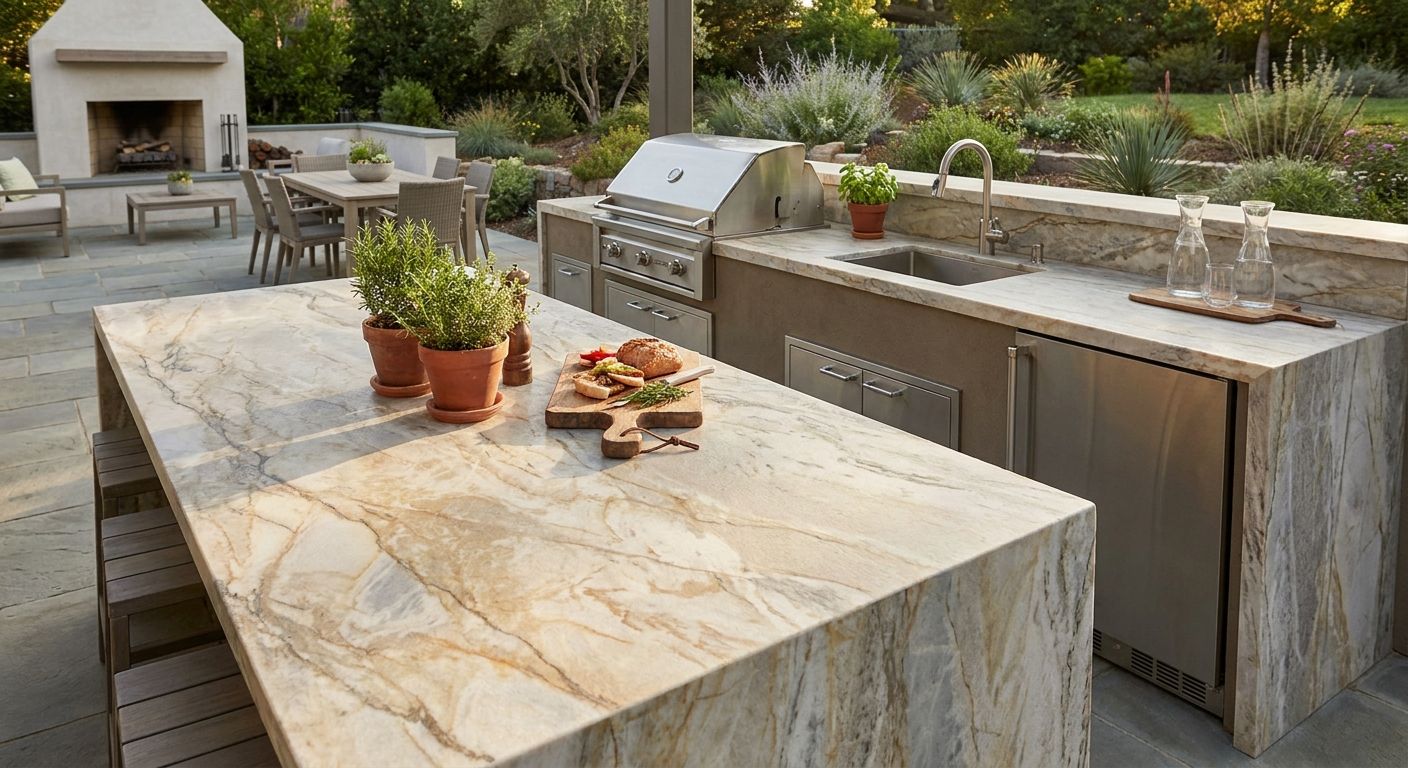
Quartzite countertops for outdoor kitchens have to survive freeze-thaw cycles, direct sun, and grill splatter that indoor slabs never see — and not every quartzite variety handles that load the same way in 2026.
- Taj Mahal Quartzite and White Macaubas handle New England freeze-thaw cycles best for quartzite countertops for outdoor kitchens in 2026 — buy either.
- Skip 2cm slabs on outdoor islands; 3cm thickness resists chipping and supports overhangs past 10 inches.
- Water absorption under 0.5% is the line between a slab that survives winter and one that spalls.
- Dyed marble sold as 'quartzite' etches and scratches outdoors within one season — verify hardness before you buy.
- Reseal outdoor quartzite twice a year; UV exposure breaks down sealer faster than it does indoors.
Why this matters
Outdoor kitchens in New England take a beating that showroom samples never account for. A slab that looks identical to an indoor quartz countertop can behave completely differently once it sits through a Massachusetts winter with a grill running six feet away.
Granite handles outdoor exposure fine, but it doesn't hide grill grease the way patterned quartzite does. Engineered quartz is a bigger risk outdoors — the resin binder in quartz starts breaking down under sustained heat above roughly 150°F, which rules it out anywhere near a built-in grill or pizza oven. True quartzite, by contrast, is a natural metamorphic stone that tolerates direct sun, frost, and radiant heat without the resin problem.
The catch: the stone industry uses "quartzite" loosely, and some slabs marketed under that name are actually dyed marble or dolomite with none of the durability. Getting this decision right before fabrication starts saves a full slab replacement two winters later.
Who this is for
This guide is for New England homeowners planning or renovating an outdoor kitchen — grill island, bar counter, or pizza oven surround — who want a natural stone surface that survives freeze-thaw cycles without babying it every spring. If you're comparing custom quartzite countertops against granite or engineered quartz for an exterior build, the criteria below apply whether you're finishing a full outdoor kitchen or just capping a grill island.
What to look for in quartzite for outdoor kitchens
Water absorption rate
Water absorption under 0.5% is the number that matters most for any stone sitting outside through a New England winter. Anything higher lets moisture into the stone's pores, and repeated freeze-thaw cycles turn that trapped water into cracks and surface spalling. Ask your fabricator for the absorption spec on the specific block, not just the stone name — absorption varies by quarry lot.
Heat and UV stability
Direct grill heat and unfiltered sun are constants on an outdoor counter, and quartzite handles both without discoloring or softening. Unlike engineered quartz, there's no resin binder to break down, so a grill running next to the slab for years doesn't leave a scorch halo. Color also holds up under UV exposure better than dyed or resin-treated stones, which fade or yellow within a couple of summers.
Slab thickness
3cm is the standard thickness for any outdoor quartzite installation — 2cm slabs that work fine indoors chip and crack under outdoor thermal cycling. If your design calls for an overhang past 10 inches on a grill island, 3cm with a support bracket is non-negotiable, not optional.
Material verification
Some slabs sold as "quartzite" are dyed marble or dolomite, and the difference matters more outdoors than anywhere else in the house. True quartzite scores 7 on the Mohs hardness scale; marble sits around 3-4 and etches from acidic splatter, rain runoff carrying pollen acid, and even citrus marinades. If a fabricator can't confirm the hardness rating with a scratch test or lab documentation, treat it as a red flag — the piece covered in more detail in this comparison of quartz and quartzite walks through how to tell the materials apart before you sign off on a slab.
Sealing schedule
Outdoor quartzite needs sealing roughly twice a year instead of the once-a-year schedule that works indoors, because UV and rain break the sealer down faster. Skipping a reseal doesn't ruin the stone immediately, but it does open the door to staining from tannins, grease, and mineral deposits from sprinklers.
Edge profile
Eased or bullnose edges hold up to bumps from grill tools and outdoor furniture far better than sharp square edges, which chip first on exterior installs. It's a small spec that gets overlooked in the design phase and shows up as a repair call the following spring.
Top picks by variety
Taj Mahal Quartzite — the safe pick. Cream-and-gold veining with water absorption typically under 0.1%, making it one of the most weather-stable quartzite options for outdoor kitchens. It resists staining from grill grease and holds its color through direct sun exposure. Buy.
White Macaubas — the marble look-alike that actually holds up. Reads like Calacatta marble at a glance but carries true quartzite hardness around 7 on the Mohs scale, so it won't etch from lemon juice or vinegar-based marinades the way real marble does outdoors. Slightly higher cost than mid-range granite, but the visual payoff for an outdoor bar counter is real. Consider.
Fusion Quartzite — the bold veining pick. Deep blue-grey background with dramatic white movement; performs well in freeze-thaw testing but the pattern variation between slabs is significant, so see the actual block before ordering. Consider.
Sea Pearl Quartzite — the wildcard. Green-grey base with mineral flecking that hides grill soot better than lighter stones, but slab availability runs inconsistent year to year. If your fabricator has stock on hand, it's worth a look for a grill island specifically. Consider.
Blue Louise Quartzite — the splurge. Striking blue-grey veining that reads almost like granite from a distance, with the same low absorption profile as Taj Mahal. Costs more per square foot than the other picks here, but it's the one stone on this list that reads as a statement piece rather than a background surface. Buy if budget allows.
What to avoid
- Dyed "quartzite" that's really marble or dolomite. It photographs identically in a showroom and etches within one grilling season outdoors. Insist on a hardness verification before fabrication.
- 2cm slabs on any exterior installation. They're common indoors and cheaper, but they crack under the thermal swings an outdoor kitchen sees between a summer afternoon and a fall night in New England.
- Resin-heavy fillers on fissures. Quartzite naturally has fissures that get filled during fabrication; low-quality resin fillers degrade under UV and leave visible pitting within two to three years outdoors.
Plan your outdoor kitchen slab
Get a quote on quartzite fabrication and installation for New England outdoor kitchens.
Verdict comparison
| Variety | Water absorption | Best for | Verdict |
|---|---|---|---|
| Taj Mahal Quartzite | Under 0.1% | Grill islands, high-sun exposure | Buy |
| White Macaubas | Low | Bar counters, marble look | Consider |
| Fusion Quartzite | Low, varies by block | Statement islands | Consider |
| Sea Pearl Quartzite | Low | Hiding grill soot | Consider |
| Blue Louise Quartzite | Under 0.1% | Splurge feature counters | Buy |
FAQ
What's the best quartzite for outdoor kitchens in 2026?
Taj Mahal Quartzite and Blue Louise Quartzite are the top picks for outdoor kitchens in 2026 based on low water absorption and stable coloring under sun exposure. Both hold up through New England freeze-thaw cycles without sealing more than twice a year.
Is quartzite better than granite for outdoor kitchens?
Quartzite and granite both perform well outdoors, but true quartzite scores harder on the Mohs scale and resists etching from acidic splatter better than most granites. Granite remains a solid, often more affordable option if pattern preference favors it.
Can you use quartz countertops outdoors instead of quartzite?
Engineered quartz is not recommended for outdoor kitchens because its resin binder starts breaking down under sustained heat above roughly 150°F, which is common near a grill. Natural quartzite has no resin binder and handles that heat without damage.
How thick should outdoor quartzite countertops be?
3cm is the standard thickness for outdoor quartzite installations, since 2cm slabs crack under the thermal swings that come with New England seasons. Overhangs past 10 inches need a support bracket regardless of thickness.
How often do you need to seal outdoor quartzite?
Outdoor quartzite needs resealing about twice a year, compared to once a year for the same stone indoors. UV exposure and rain break the sealer down faster outside.
Does quartzite crack in freezing temperatures?
Quartzite with water absorption under 0.5% resists freeze-thaw cracking because there's little moisture trapped in the stone's pores to expand when it freezes. Higher-absorption slabs are the ones that spall after a few winters.
How do you tell real quartzite from dyed marble?
Real quartzite scores around 7 on the Mohs hardness scale and won't scratch with a steel blade, while dyed marble sits around 3-4 and scratches easily. Ask your fabricator for hardness documentation before ordering a slab for an outdoor kitchen.
What edge profile works best for outdoor quartzite counters?
Eased or bullnose edges hold up better to bumps from grill tools and outdoor furniture than sharp square edges. Square edges are more prone to chipping on exterior installations.
One last thing
The detail most homeowners skip: ask to see the actual slab your fabricator will cut from, not just a sample chip. Quartzite veining and mineral flecking vary block to block, and the stone that looks perfect on a 4x4-inch sample can read completely differently across a 10-foot grill island once it's cut and polished in 2026 daylight.