Marble countertops for bathroom vanities bring a cool, veined surface into a room that sees more standing water, toothpaste acid, and perfume overspray than any kitchen counter ever will — the finish you pick determines whether that surface still looks good in five years.
- Marble countertops for bathroom vanities need a honed or leathered finish, not polished, to hide etching from toiletries.
- Vermont Danby Marble, quarried in New England, resists staining better than soft Calacatta Gold on daily-use vanities.
- Reseal a marble vanity top every 6 to 12 months with a penetrating sealer or expect water spotting by year two.
- Skip cultured marble imitations for real vanities — they yellow over time and cannot be re-honed like natural stone.
- Soares Stone fabricates and installs custom marble vanity tops across New England as of 2026.
Why this matters
A kitchen island gets wiped down after dinner. A bathroom vanity gets hit with mouthwash, nail polish remover, hairspray, and standing puddles from a running faucet, sometimes daily, for years without a second thought.
Marble is calcium carbonate — soft, at roughly 3 on the Mohs hardness scale, and reactive to anything acidic. That's exactly why marble countertops for bathroom vanities need a different buying approach than marble for a kitchen island. Get the finish and sealing schedule wrong and you'll see dull etch marks within months. Get it right and a marble vanity top can outlast the cabinetry underneath it.
Soares Stone fabricates and installs custom stone vanity tops for homeowners across New England, and the same slab that looks stunning in a showroom photo can behave completely differently in a humid, high-splash bathroom. The decision isn't just aesthetic — it's about matching the stone's porosity and hardness to how the room actually gets used.
Who this is for
This guide is for homeowners renovating a primary or guest bathroom who want the look of natural veined stone on a vanity and are weighing marble against granite, quartz, or quartzite. It's built for people replacing an existing top, not for a full custom build where a designer has already locked in the slab. If you want a maintenance-free surface and never plan to reseal anything, marble is the wrong stone regardless of which type you pick — that tradeoff needs to be settled before you fall in love with a slab.
What to look for in marble countertops for bathroom vanities
Finish: honed beats polished for daily use
A polished marble finish shows every water spot and etch mark because the reflective surface makes any dulled spot stand out immediately. A honed (matte) or leathered finish already has a soft, low-sheen surface, so early etching from toothpaste or perfume blends in instead of standing out. For a vanity that gets touched every morning and night, honed is the practical call in 2026, even though polished still wins on kitchen islands where the look matters more than the wear pattern.
Porosity and sealing frequency
Every marble slab needs sealing, but not every marble is equally porous. Denser stones like Vermont Danby Marble hold a sealer longer than calcite-heavy stones like Calacatta Gold, which can need resealing every 6 months instead of every 12. Ask your fabricator for the specific porosity of the slab you're buying, not just the marble variety name, since porosity varies by quarry lot.
Slab thickness for vanity spans
Most bathroom vanities run 2cm or 3cm thick. A 3cm slab resists chipping at the sink cutout and front edge better than 2cm, which matters more on a vanity than a kitchen counter because vanities get bumped by doors, stools, and dropped hair tools constantly. Thinner slabs need plywood backing for support, which adds a step most homeowners don't budget for upfront.
Vein movement and mirror pairing
A vanity top sits directly under a mirror, so the veining reads as a focal point in a way it never does on a kitchen counter tucked under cabinets. Bold, dramatic veining like Calacatta or Statuario draws the eye and works in a larger bathroom; subtle, tight veining like Carrara reads calmer in a small powder room where a busy pattern would feel crowded.
Color undertone against cabinetry and fixtures
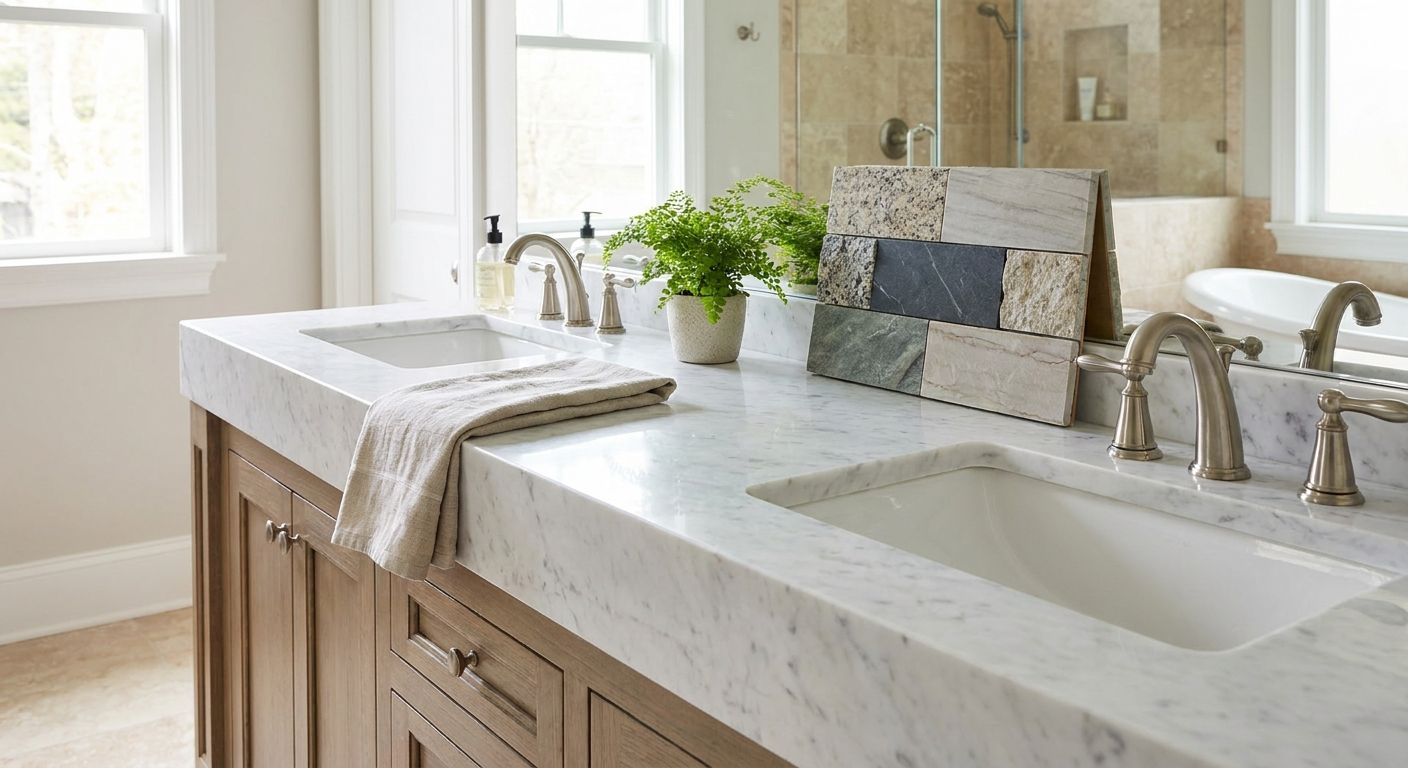
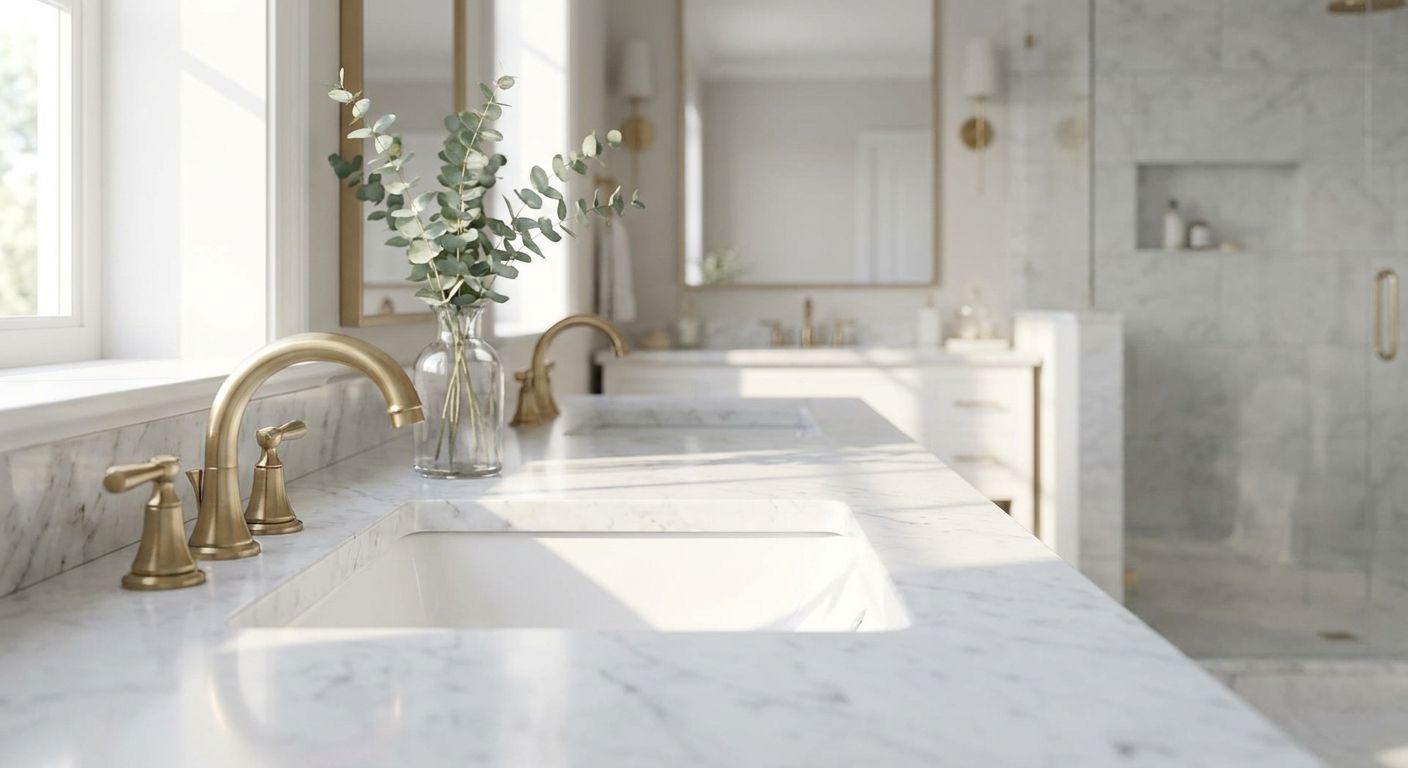
Warm-toned marbles like Crema Marfil pair with warm wood vanities and brass fixtures; cool-toned marbles like Carrara or Vermont Danby pair with white or gray cabinetry and chrome or nickel fixtures. Mixing undertones is the single most common regret homeowners report after installation, because a slab photographed under showroom lighting can shift noticeably under bathroom vanity lighting at home.
Edge profile and splash exposure
A vanity near a soaking tub or a shower with a swinging door gets more incidental water contact than one tucked in a dry corner. A rounded or bullnose edge sheds water better than a sharp square edge, which can trap moisture at the seam over time and accelerate staining right at the point of contact.
Get a marble vanity quote
Soares Stone fabricates and installs custom marble vanity tops across New England.
Top picks for bathroom vanities
Carrara White — the safe pick. Subtle gray veining on a bright white base, roughly 3 on the Mohs scale, moderate porosity. It's the most widely available marble in North America, which keeps sourcing predictable and matching slabs across a double vanity easier. Verdict: Buy for most primary and guest bathrooms where you want stone character without a bold statement.
Calacatta Gold — the statement piece. Bold gold-and-gray veining on a warmer white base, but the thick, calcite-rich veins are softer and more porous than the surrounding stone, meaning uneven wear over years. It photographs beautifully and it's the marble most homeowners point to in inspiration photos. Verdict: Consider for a low-use guest bath or powder room, not a primary vanity used twice a day by multiple people.
Vermont Danby Marble — the New England local pick. Quarried in Vermont, this marble runs denser and less porous than most Italian imports, with tighter, more uniform veining. It holds a seal longer and shows less staining in humid New England bathrooms specifically. Verdict: Buy for homeowners who want a durable marble without shipping a slab across an ocean.
Crema Marfil — the warm alternative. A beige-toned Spanish marble with soft, fine veining, moderate porosity similar to Carrara. It works especially well against warm wood vanities and brass hardware where a stark white marble would clash. Verdict: Consider when your cabinetry and fixtures already lean warm.
Statuario — the wildcard. Dramatic, thick gray veining on a bright white ground, prized for its movement but among the softer and more porous marbles commonly sold for vanities. It needs more frequent sealing and careful use of pH-neutral cleaners to avoid dulling the polish quickly. Verdict: Skip for a heavily used primary vanity; Consider for a statement powder room seen more than touched.
What to avoid
- Polished finish in a small, steamy bathroom. It looks sharp on day one and shows every water spot by month three — honed almost always ages better in a high-humidity room.
- Cultured marble imitations marketed as "marble." These are resin-and-stone composites, not natural stone; they yellow with UV exposure and can't be re-honed or refinished the way real marble can.
- Skipping the resealing schedule because the countertop is new. A fresh slab still needs its first seal at install and a repeat seal within a year — waiting until you see a water ring means the damage already happened.
Verdict comparison
| Marble Type | Hardness (Mohs) | Porosity | Best For | Verdict |
|---|---|---|---|---|
| Carrara White | ~3 | Moderate | Most primary & guest baths | Buy |
| Vermont Danby | ~3-4 | Low | Humid, daily-use vanities | Buy |
| Crema Marfil | ~3 | Moderate | Warm-toned cabinetry pairing | Consider |
| Calacatta Gold | ~3 | Higher | Low-use guest bath, powder room | Consider |
| Statuario | ~3 | Higher | Statement powder rooms only | Skip / Consider |
If you're still torn between marble and an engineered alternative for a busier bathroom, the tradeoffs on hardness and staining resistance are laid out in how to choose between quartz and quartzite countertops — worth a read before you commit to natural stone on a high-traffic vanity.
FAQ
What's the best marble for a bathroom vanity?
Carrara White and Vermont Danby Marble are the best marble countertops for bathroom vanities because both run denser and less porous than veinier options like Calacatta Gold or Statuario. Vermont Danby has the added edge of being quarried in New England, which typically means tighter, more uniform veining.
Is marble too soft for a bathroom countertop?
Marble sits around 3 on the Mohs hardness scale, softer than granite or quartz, but it holds up fine on a vanity with a honed finish, regular sealing, and pH-neutral cleaners. It's not the right choice if you want a zero-maintenance surface.
How much does marble stain compared to quartz?
Marble stains and etches far more easily than quartz because it's a porous natural stone reactive to acids, while quartz is a sealed engineered surface that resists both. Quartz wins on stain resistance; marble wins on natural veining and cool surface feel.
Should I choose honed or polished marble for a vanity?
Honed marble is the better choice for a bathroom vanity because its matte finish hides early etch marks that a polished, reflective surface makes obvious. Polished marble still makes sense for lower-use kitchen counters or statement powder rooms.
How often do marble vanity tops need sealing?
Most marble vanity tops need resealing every 6 to 12 months, with more porous marbles like Calacatta Gold on the shorter end of that range. Denser stones like Vermont Danby can stretch closer to the 12-month mark.
Is Calacatta or Carrara better for a small bathroom?
Carrara's subtle, tight veining generally reads calmer in a small bathroom, while Calacatta's bold gold veining can feel busy in a tight space. Calacatta works better in larger primary bathrooms where the veining has room to breathe.
Can marble vanity tops be repaired if etched?
Light etching on a honed marble vanity can often be re-honed or buffed out by a fabricator, restoring the matte finish. Deep etching or chips usually require professional refinishing rather than a DIY fix.
How much does a marble vanity top cost in 2026?
Cost depends on slab grade, thickness, edge profile, and vanity size, so pricing varies project to project in 2026. Get a specific quote from a fabricator once you've picked a marble type and finish.
One last thing
The marble variety matters less than most homeowners assume — porosity varies by quarry lot even within the same named stone, so two "Carrara" slabs can seal and stain differently. Ask to see the actual slab your vanity top will be cut from, not just a sample chip, before you sign off in 2026.