Small kitchens punish bad material choices fast — a busy pattern or an oversized slab seam turns a tight galley into visual clutter within the first week of living with it. Quartz countertops for small kitchens work when the slab, edge, and layout are chosen for a room you can cross in three steps, not a showroom island.
- Quartz countertops for small kitchens should stay light-toned or subtly veined — busy patterns shrink a room visually.
- A 2cm slab with a mitered edge reads as substantial without eating counter depth. Buy this over thick 3cm slabs in tight galleys.
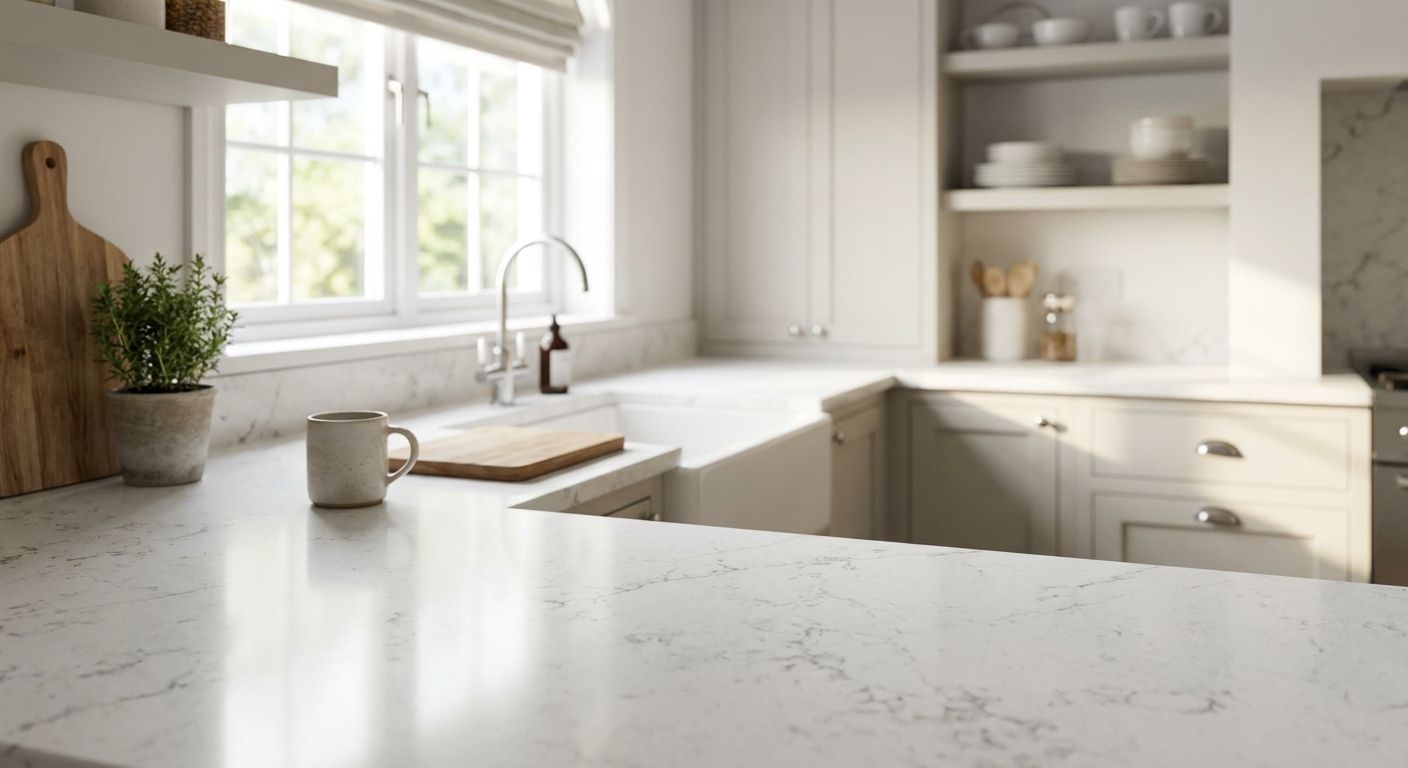
- Solid white and warm greige quartz hide seams best in kitchens under 150 square feet.
- Skip heavily veined 'marble-look' quartz in a small kitchen — the pattern fights the room instead of opening it up.
- One continuous slab beats a patterned seam match for kitchens with a single 8 to 10 foot run.
Why this matters
A countertop decision is one of the few kitchen choices you live with for 15-plus years without repainting or swapping hardware. In a small kitchen, the surface reflects more light per square foot than in a large one, so the wrong color or pattern gets magnified rather than diluted by cabinetry and floor space.
Soares Stone fabricates and installs quartz, granite, marble, and quartzite for New England kitchens, and the small-kitchen jobs share one pattern: clients who pick slab and edge profile based on the room's actual dimensions outperform clients who pick based on a showroom sample. That distinction drives everything below.
Who this is for
This guide is for homeowners working with a kitchen footprint under roughly 150 square feet — galley layouts, condo kitchens, older New England homes with a single 8 to 10 foot counter run, or a U-shaped kitchen with limited wall space. If your kitchen has an island larger than 6 feet or an open-concept layout that reads as one big room, the calculus changes and slab pattern matters less.
What to look for in quartz countertops for small kitchens
Slab tone and light reflectance
Lighter quartz — whites, warm greiges, pale grays — bounces more ambient light around a tight room than dark quartz does. A small kitchen with limited window exposure benefits more from tone than from pattern drama, since darker slabs like black or deep charcoal quartz absorb light and make a galley feel narrower than it is.
Pattern scale
Veining and movement that looks elegant on a 10-foot island reads as noise on a 4-foot run. Pick a pattern scaled to the actual counter length: subtle, low-contrast veining or a near-solid look holds up better than a bold Calacatta-style pattern crammed into a short span.
Slab thickness
Quartz comes standard in 2cm and 3cm thickness. In a small kitchen, 2cm with a properly supported substrate and a built-up edge gives you the visual heft of 3cm without the extra depth pressing into limited cabinet clearance or overhang space near a stove.
Seam placement
A kitchen under 10 feet of counter run can often be fabricated from a single slab with zero visible seams — ask specifically about this before ordering. Seams draw the eye in a small space far more than in a large one, so fewer seams matter disproportionately here.
Edge profile
A simple eased or mitered edge keeps a small counter looking clean; heavily ornate edges (bullnose, ogee) add visual weight that a tight kitchen doesn't have room to absorb. Edge choice also affects how much usable depth you lose to overhang and drip groove.
Backsplash coordination
Small kitchens read as one continuous surface when the countertop and backsplash share tone. A full-height quartz backsplash in the same slab extends the counter visually and eliminates a seam line that would otherwise chop the wall into segments.
Top picks for small kitchens
Solid white quartz — the safe pick. Near-zero pattern variation means zero pattern-scale problems. Solid white hides seams within 1/16 inch when fabricated correctly and reflects the most ambient light of any quartz tone. Buy for galley kitchens with limited natural light.
Warm greige quartz with subtle veining — the workhorse. Light enough to open up a room, textured enough to hide daily wear like water spots and crumbs better than pure white. Works with both white and stained wood cabinetry. Buy for kitchens that double as the main living space in a condo.
Soft gray quartz with fine veining — the wildcard. Reads neutral in photos but picks up warm or cool undertones depending on lighting, so it needs an in-person slab viewing before committing. Pairs well with black hardware and brass fixtures alike. Consider if you've already picked fixtures and need the counter to match rather than lead.
Concrete-look gray quartz — the modern pick. Flat, low-variation texture with minimal pattern, which keeps a small kitchen calm rather than busy. Reads industrial, so it fits better with slab cabinetry than with traditional raised-panel doors. Consider for a condo renovation, Skip for a colonial-style New England kitchen.
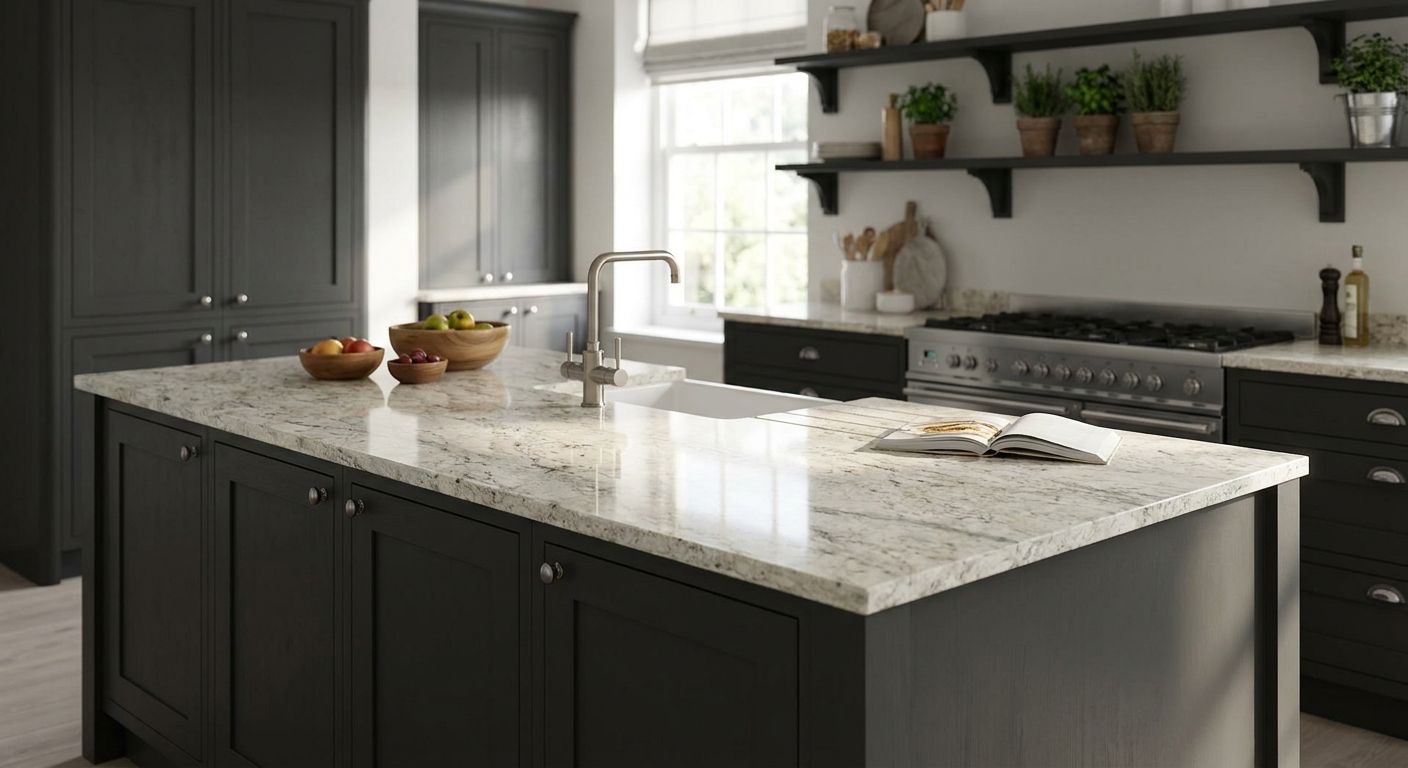
Bold Calacatta-look quartz with heavy veining — the showroom favorite. Dramatic gold-gray veining that photographs beautifully on a 10-foot island slab. In a 4 to 6 foot galley run, the pattern gets cut into fragments that look chaotic rather than elegant. Skip for any kitchen under 150 square feet.
Before ordering any of these, review the difference between quartz and quartzite — engineered quartz behaves differently under heat and requires less sealing than natural quartzite, and this comparison walks through which surface fits which use case.
“If the slab pattern reads busy at six feet, it will overwhelm a kitchen you can cross in three steps.”
What to avoid
- Heavily patterned "marble-look" quartz with high-contrast veining. It looks premium in a showroom slab 10 feet wide and looks chopped-up on a 5-foot counter run.
- 3cm slabs on kitchens with tight stove clearance. The extra centimeter of thickness can crowd overhang space near appliances in a galley layout.
- Ornate edge profiles on short runs. A double-ogee edge on a 4-foot counter draws attention to how short the run actually is instead of disguising it.
Verdict comparison
| Quartz style | Best for | Seam visibility | Verdict |
|---|---|---|---|
| Solid white | Low-light galley kitchens | Nearly invisible | Buy |
| Warm greige, subtle vein | Everyday family kitchens | Low | Buy |
| Soft gray, fine vein | Kitchens matching mixed fixtures | Low-moderate | Consider |
| Concrete-look gray | Modern condo renovations | Low | Consider |
| Bold Calacatta-look | Large islands, open layouts | High in short runs | Skip (small kitchens) |
Get a quote for your kitchen
Custom quartz fabrication and installation across New England.
FAQ
What's the best quartz color for a small kitchen?
Solid white or warm greige quartz works best for small kitchens because it reflects more light and hides seams better than heavily veined patterns. Darker tones and bold Calacatta-look veining tend to make tight galley layouts feel more cramped in 2026.
Is quartz better than granite for a small kitchen?
Quartz generally works better than granite in small kitchens because it comes in more consistent, low-pattern colors that suit tight spaces, and it doesn't need periodic sealing. Granite can still work if you pick a slab with minimal pattern variation.
How much does quartz countertop installation cost in 2026?
Costs vary by slab grade, edge profile, and square footage, so get a project-specific quote rather than relying on a national average. Small kitchens often cost less in total dollars simply because they need fewer square feet and fewer seams.
Can a small kitchen have a seamless quartz countertop?
Yes — a counter run under about 10 feet can often be fabricated from a single slab with no visible seam, depending on layout and corner configuration. Confirm seam placement during the template and fabrication stage, not after installation.
Should I use 2cm or 3cm quartz in a small kitchen?
2cm quartz with a properly built-up edge gives the visual thickness of 3cm without eating into cabinet clearance, which matters more in a small kitchen than in a large one. 3cm can still work if overhang space near appliances isn't tight.
Does a light-colored backsplash matter with light quartz countertops?
Matching the backsplash tone to the countertop in a small kitchen removes a visual break and makes the wall read as one continuous surface. A full-height quartz backsplash in the same slab is the strongest version of this approach.
What quartz pattern should I avoid in a galley kitchen?
Avoid high-contrast, large-scale veining like bold Calacatta-look quartz on counter runs under 6 feet, since the pattern gets cut into fragments that look busy rather than elegant. Save dramatic veining for larger islands or open-concept kitchens.
How do I know if a quartz slab will look too busy in my kitchen?
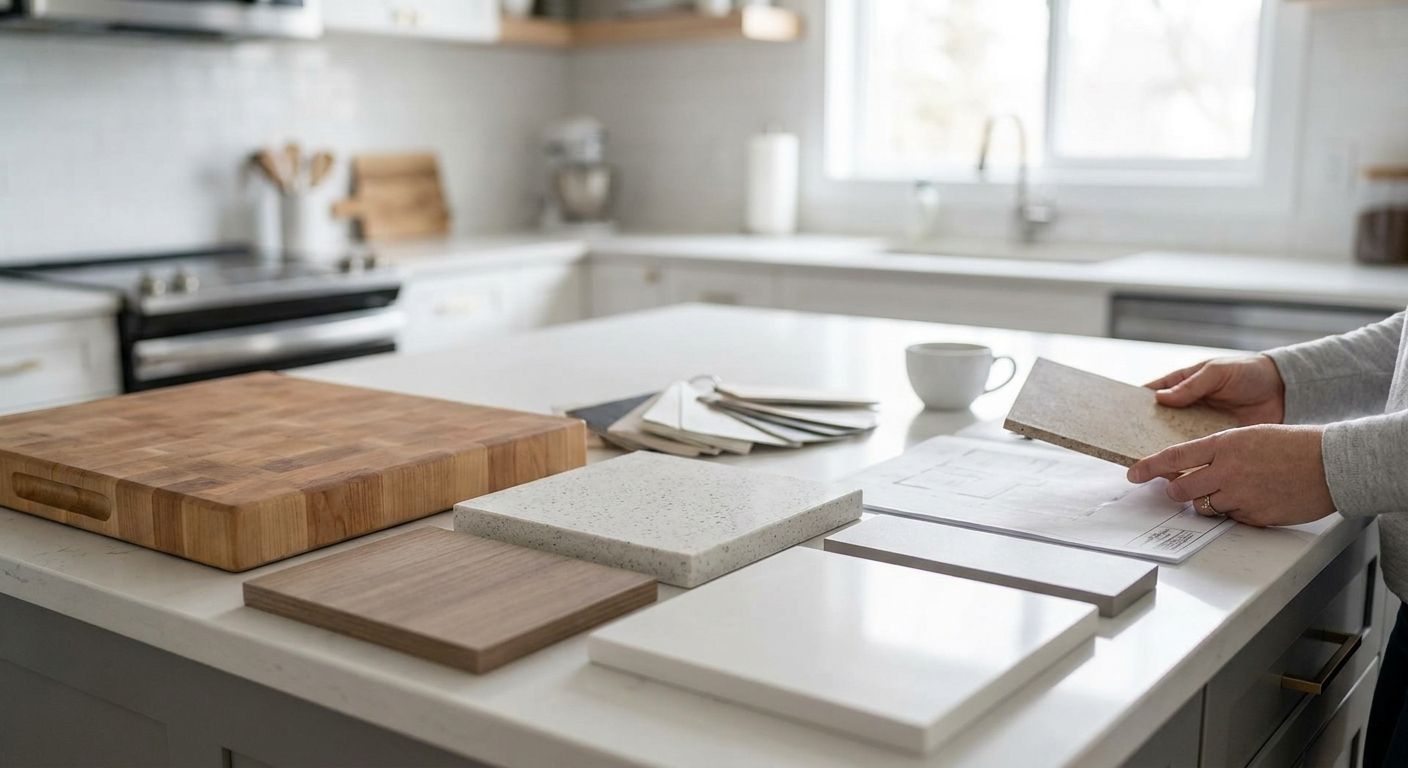
Hold a full slab sample against your actual counter run length before ordering, not just a small swatch, since pattern scale reads differently at 4 feet than at 10 feet. If the veining looks chaotic at the true dimension, pick a calmer pattern.
One last thing
The single most-skipped step in small-kitchen quartz projects is viewing a full slab, not a swatch, against the actual counter dimensions before signing off — a 4-inch sample tells you almost nothing about how a pattern scales across a 5-foot run. Ask to see the full slab your fabricator plans to cut from, laid out at true size, before it goes under the saw.