Granite countertops for kitchen islands take more daily abuse than any other surface in the house — hot pots, knife nicks, kids' homework, and every dinner party landing spot. Picking the wrong slab means living with scratches and seams you notice every single day for the next 20 years.
- Granite countertops for kitchen islands need at least 3cm (1.25-inch) thickness for unsupported overhangs past 10 inches.
- Bianco Antico is the safe pick for resale-minded New England kitchens — buy it.
- Black Galaxy hides scratches best on a high-traffic island — buy it if budget allows.
- Skip remnant slabs under 2cm for islands; they crack under overhang stress.
- Soares Stone fabricates and templates islands on-site to match seam placement to your layout.
Why this matters
An island slab isn't the same purchase as a perimeter countertop. It's viewed from four sides instead of one, it usually carries an overhang for seating, and it's the piece everyone touches first when they walk into the kitchen.
Granite is still the default choice for islands in 2026 because it's heat-resistant to direct pan contact and holds up to knife drops that would chip a laminate or dent butcher block. But not every slab performs the same under an overhang, and not every pattern reads well when it's the centerpiece of the room rather than a backdrop.
Who this is for
This guide is for homeowners planning a kitchen island — new build or remodel — who want a slab that survives daily cooking abuse and looks intentional from every angle, not homeowners doing a quick perimeter swap where matching an existing counter matters more than statement pattern. If you're weighing granite against engineered stone for the whole kitchen, Soares Stone's guide to choosing between quartz and quartzite covers that decision in more depth before you commit to natural stone.
What to look for in granite countertops for kitchen islands
Slab thickness and edge profile
Islands need 3cm (1.25-inch) slabs, not the thinner 2cm option some fabricators push for perimeter runs. A 2cm slab flexes under an overhang and is far more likely to crack at a seam or a corner where someone leans while pulling up a stool.
Overhang support for seating
Anything past a 10 to 12-inch overhang needs corbels or a steel support bracket underneath — granite has no give, and an unsupported overhang eventually stress-cracks along the grain line. Ask your fabricator to spec the support before templating, not after the slab is cut.
Seam placement and slab size
A standard granite slab runs roughly 9 by 5.5 feet, so most islands under 10 feet don't need a seam at all. If your island is longer, seam placement should land in a low-visibility spot — never dead center of the workspace — and pattern should be matched across the seam, not just color.
Color and pattern movement
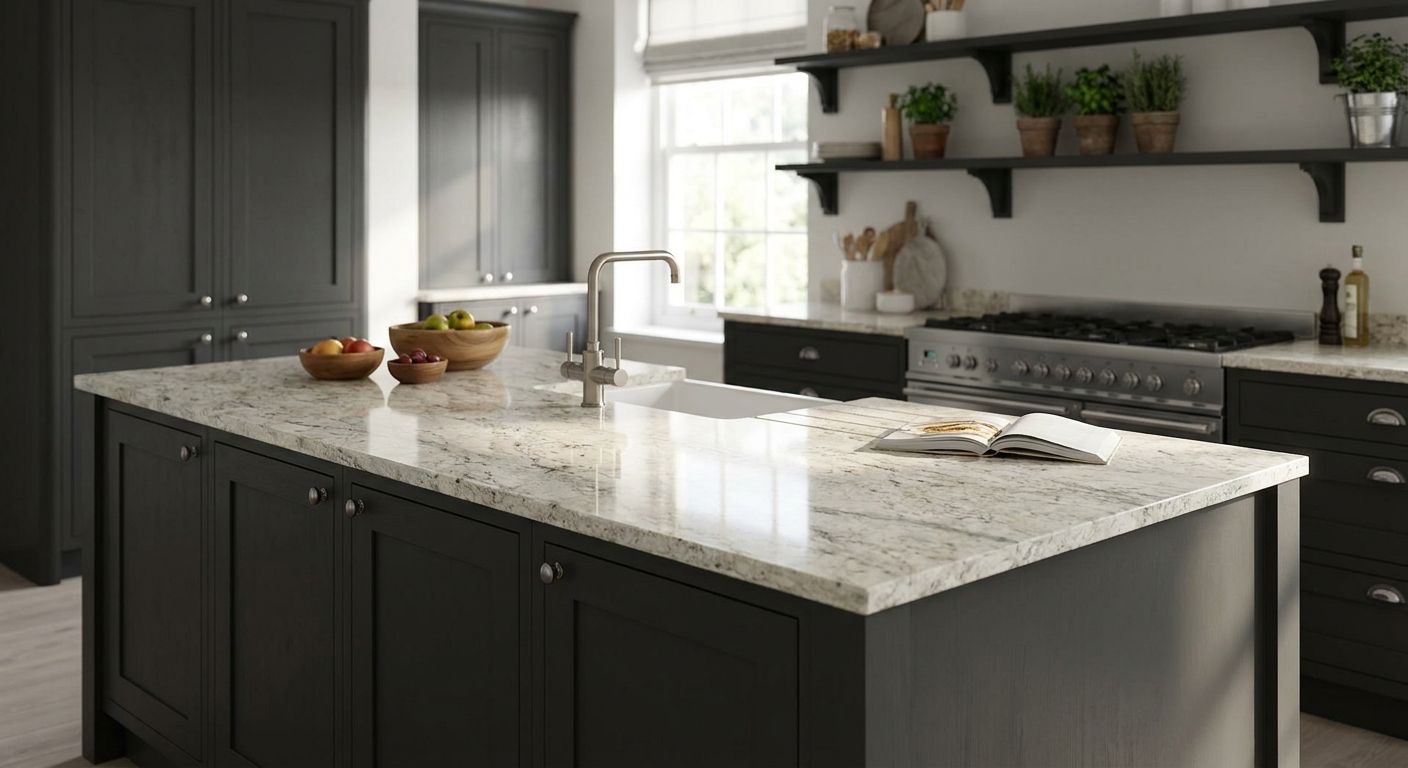
An island is viewed from every angle, so busy patterns with strong directional veining can look chaotic once you're standing on the opposite side from where the slab was cut. Granular, evenly distributed patterns like Bianco Antico or Giallo Ornamental tend to read cleaner from all four sides than bold-vein slabs like some marbles.
Heat and scratch resistance
Granite sits around a 6 to 7 on the Mohs hardness scale, which handles direct pan contact and everyday knife use without scoring — something quartz's resin binder can't always claim near a stove edge. This is the single biggest reason granite still wins the island debate over quartz for cooking-heavy households.
Sealing and maintenance
Granite is porous and needs sealing on installation, then roughly once a year depending on the stone's density — darker, denser granites like Absolute Black go longer between resealing than lighter, more porous stones. Skipping this step is the number one reason granite owners complain about staining, and it's almost never the stone's fault.
Get a free island quote
Soares Stone templates and fabricates island slabs across New England.
Top picks for kitchen islands
Bianco Antico — the safe pick. Cream background with burgundy and black flecks, evenly distributed so it reads consistent from all four sides of the island. Mohs hardness around 6.5, and it's one of the most widely stocked slabs in New England yards, which keeps lead times short. Buy if you want a pattern that won't fight your cabinetry or your resale value in 2026.
Black Galaxy — the bold statement. Deep black with copper and gold mineral flecks that catch light from any angle, which is exactly why it works as an island rather than a perimeter run. It's a denser, harder-wearing granite that hides scratches and water spots better than lighter stones. Buy if the island is meant to be the visual anchor of an open-concept kitchen.
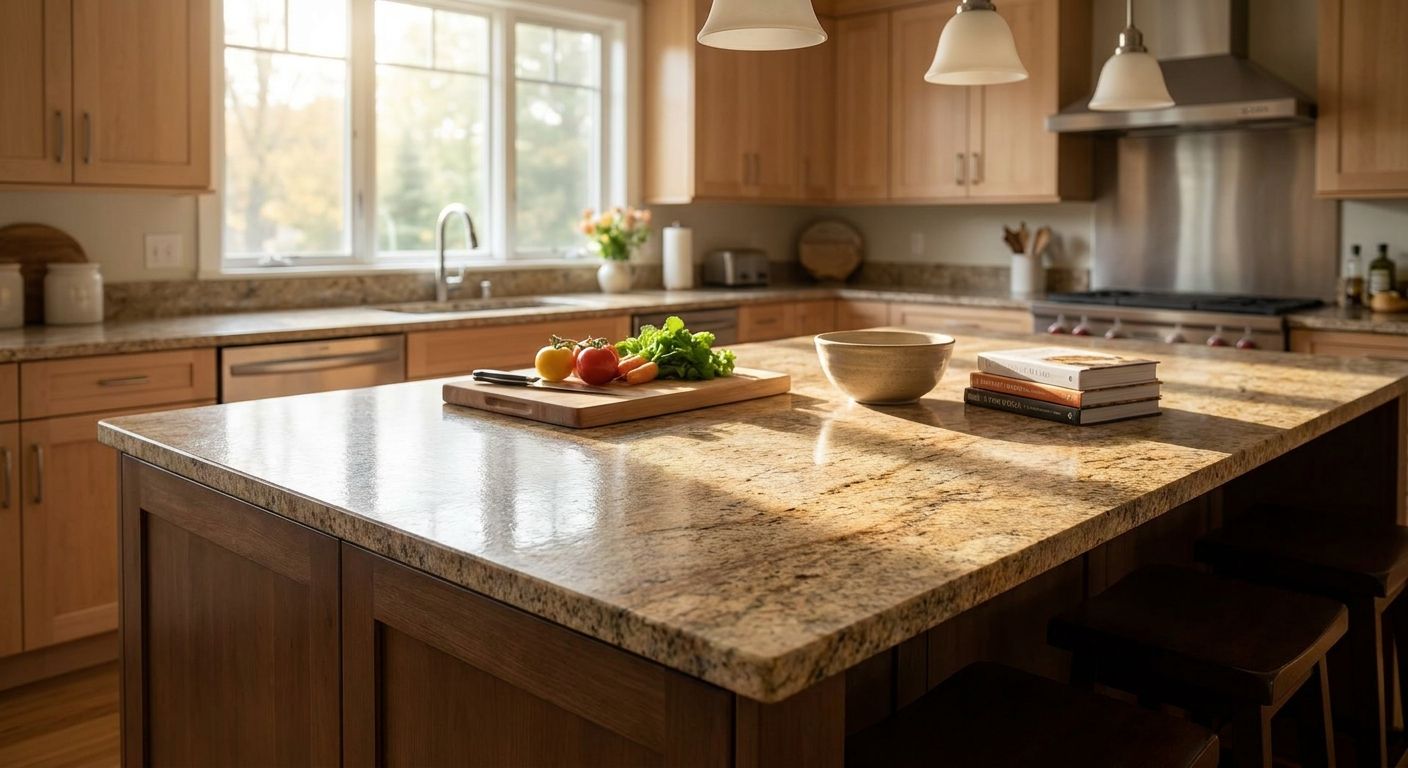
Giallo Ornamental — the budget pick. Warm gold and cream background with soft gray veining, typically priced lower per square foot than exotic granites because it's quarried in higher volume. It's forgiving of small scratches since the pattern already has visual texture. Buy if you want granite's durability without paying for a rare slab.
Blue Pearl — the wildcard. Silvery-blue background with a shimmering crystalline flake that shifts under different lighting, sourced from Norway rather than the more common Brazilian and Indian quarries. It reads dramatically different under warm LED versus daylight, so see it under your actual kitchen lighting before ordering. Consider it only if you've confirmed the look under your own fixtures — otherwise Skip.
Absolute Black (leathered finish) — the low-maintenance pick. A honed or leathered finish on Absolute Black hides fingerprints and water spots far better than the polished version, which matters on an island that gets touched from every side all day. It also masks small scratches better than a high-gloss finish. Buy if fingerprints on a polished surface are already a daily complaint in your current kitchen.
What to avoid
- Remnant slabs under 2cm. They're cheaper because they're leftover cuts, but they don't have the thickness to handle an island overhang without support failure.
- Mismatched veining direction across a seam. A fabricator who doesn't dry-lay the slab pieces before cutting can hand you a seam where the pattern visibly breaks — check the layout before the saw runs, not after installation.
- Skipping the support bracket to save on labor. An unsupported 15-inch overhang on 3cm granite will eventually crack along a natural fissure line, and granite doesn't patch invisibly the way quartz resin can.
Verdict comparison
| Granite | Best for | Hardness (Mohs) | Verdict |
|---|---|---|---|
| Bianco Antico | Resale-focused kitchens | ~6.5 | Buy |
| Black Galaxy | Statement islands | ~7 | Buy |
| Giallo Ornamental | Budget-conscious remodels | ~6 | Buy |
| Blue Pearl | Dramatic lighting setups | ~6 | Consider |
| Absolute Black (leathered) | High-touch, low-maintenance | ~7 | Buy |
FAQ
What's the best granite for a kitchen island?
Bianco Antico and Black Galaxy are the two most reliable picks for kitchen islands in 2026 because their patterns read consistently from all four viewing angles. Bianco Antico suits resale-focused remodels, while Black Galaxy works as a bold visual anchor.
Is granite better than quartz for a kitchen island?
Granite handles direct heat from pans better than quartz, since quartz's resin binder can scorch near a stove edge. Quartz wins on zero sealing maintenance, so the right pick depends on how often the island sees direct pan contact.
How thick should granite be for a kitchen island?
Granite for a kitchen island should be 3cm (1.25 inches) thick, not the 2cm slabs sometimes used for perimeter counters. Thinner slabs flex and crack under overhang stress from seating areas.
How much overhang can granite support without brackets?
Granite supports 10 to 12 inches of overhang without additional bracing. Anything beyond that needs corbels or a steel support bracket underneath to prevent stress cracks.
How often does granite need to be resealed?
Granite needs resealing roughly once a year, though denser stones like Absolute Black can go longer between applications. Lighter, more porous granites like Bianco Antico need more frequent attention.
Does granite scratch or chip easily?
Granite sits at a 6 to 7 on the Mohs hardness scale, so it resists everyday knife and utensil scratches better than most engineered surfaces. Chips can still happen at unsupported edges or corners under heavy impact.
Can you have a seamless granite island?
Islands under roughly 10 feet in length typically don't need a seam at all, since standard granite slabs run about 9 by 5.5 feet. Longer islands need a seam placed away from the center workspace with pattern matched across it.
What granite color hides scratches and fingerprints best?
A leathered or honed finish on a dark granite like Absolute Black hides fingerprints and light scratches far better than a polished finish. The textured surface scatters light instead of showing every mark.
One last thing
Most granite complaints trace back to sealing, not the stone itself — a properly sealed slab at 3cm thickness with correct overhang support should outlast the cabinets under it. If a fabricator can't tell you the overhang support plan before templating your island, that's the question to ask before signing anything in 2026.