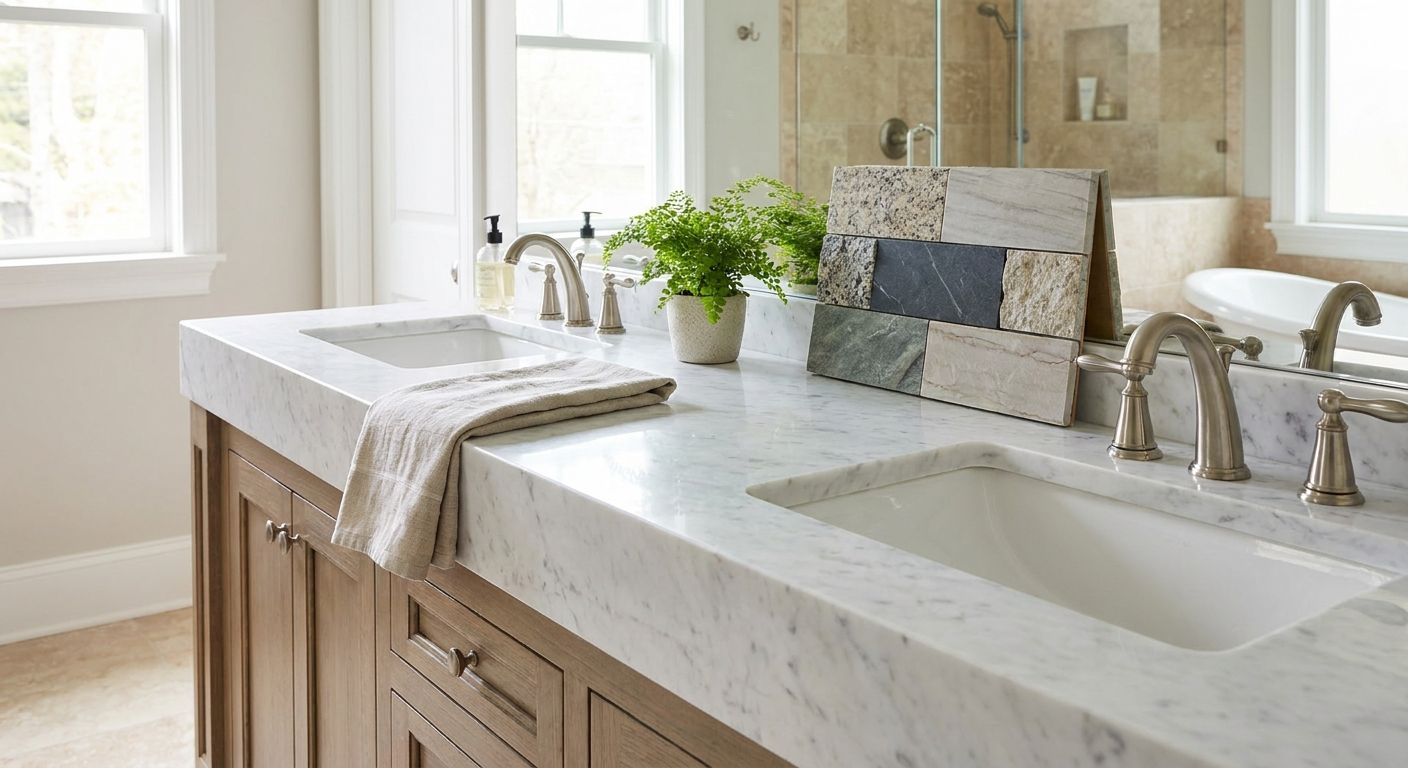
Bathroom vanities take a different kind of abuse than kitchen counters — humidity, standing water around the sink basin, and daily contact with toothpaste, mouthwash, hairspray, and skincare acids. The natural stone that wins in a kitchen island doesn't automatically win in a bathroom, and picking the wrong one means etching, staining, or a resealing schedule nobody signed up for. Here's the ranked breakdown of the natural stones actually worth putting under your bathroom sink in 2026.
- Quartzite is the best natural stone for bathroom vanities in 2026 for most New England homes — Buy.
- Granite is the dependable runner-up at nearly the same hardness — Buy.
- Marble looks the best but etches from acidic bathroom products — Consider for low-traffic powder rooms only.
- Soapstone resists staining completely but needs periodic oiling — Consider.
- Travertine is the most porous option here and the one to Skip near a wet sink basin.
Why this matters
A bathroom vanity sits inches from a running faucet, gets splashed with acidic cleaners, and holds standing water longer than a kitchen sink surround usually does. Skincare acids, whitening toothpaste, and nail polish remover will etch soft stone in months, not years. The Mohs hardness scale — the standard geology reference for scratch resistance — is the fastest way to sort which stones can take that punishment and which ones can't.
A stone that performs beautifully on a kitchen island can still be the wrong call six feet away in a bathroom, because the exposure is different, not because the stone got worse.
How we ranked
Each stone below is scored on Mohs hardness, porosity and absorption behavior, and how it holds up specifically around a vanity sink versus a kitchen work surface. The ranking reflects fabrication and installation experience with New England bathrooms, where humidity swings and hard water are constant, not seasonal.
The ranked list
1. Quartzite — the toughest natural option
Quartzite scores a 7 on the Mohs hardness scale, putting it at or above most kitchen knives and just below diamond. It resists etching from the acidic products that live on a bathroom counter — toothpaste, mouthwash, perfume — better than any other natural stone on this list.
Sealed properly, it's close to nonporous, so water rings and makeup stains wipe off instead of soaking in. For a 2026 vanity project in a household with more than one person sharing a bathroom, quartzite countertops for bathroom vanities is the option that needs the least babying over the next decade. Verdict: Buy.
2. Granite — the dependable workhorse
Granite runs 6 to 7 on the Mohs scale, close enough to quartzite that most homeowners won't notice a durability gap in daily use. It comes in a wider range of colors and price points than quartzite, which is why it's still the most common natural stone vanity material installed today.
Sealed annually, granite shrugs off hairspray overspray and hard water spots. If your household is budget-conscious but still wants real stone instead of an engineered surface, granite countertops for bathroom vanities delivers nearly quartzite-level performance. Verdict: Buy.
3. Marble — the classic showstopper with a catch
Marble is a 3 to 4 on the Mohs scale, softer than a kitchen knife blade. That softness is exactly why it etches when lemon-based cleaners, whitening toothpaste, or perfume sit on the surface too long — the acid reacts with the calcium carbonate and leaves a dull mark that polishing can't fully erase.
Marble still wins on looks: the veining reads as high-end in a way engineered surfaces struggle to match. For a guest powder room that sees light daily use, marble countertops for bathroom vanities is a reasonable call, but a busy family bathroom will show etch marks inside a year. Verdict: Consider for powder rooms, Skip for the primary bath.
4. Soapstone — the low-key dark horse
Soapstone runs 4 to 5 on the Mohs scale and is essentially nonporous, so it never needs sealing against staining the way granite or marble does. It develops a dark patina over time as homeowners apply mineral oil, which some love and others find inconsistent.
It scratches more easily than quartzite or granite, and those scratches show as lighter marks until the next oiling. For a homeowner who wants a natural stone that won't stain from cosmetics and doesn't mind a little hands-on maintenance, soapstone earns a look. Verdict: Consider.
5. Travertine — the budget stone with a leak risk
Travertine sits at 3 to 4 on the Mohs scale and comes with a naturally pitted, porous surface structure that even filling and sealing doesn't fully close off. Around a vanity sink, that porosity means water, soap scum, and grime work into the surface faster than with any other stone on this list.
It's usually the cheapest natural stone option in a fabricator's inventory, which explains why it still gets specified for vanities despite the tradeoffs. In a wet zone that sees standing water daily, travertine is the stone most likely to disappoint by 2027. Verdict: Skip.
6. Honorable mention — engineered quartz
Quartz isn't a natural stone — it's roughly 90-95% ground quartz mineral bound with resin — but it comes up constantly in vanity comparisons because it never needs sealing and resists both staining and etching better than marble. If a homeowner is choosing between a genuinely natural stone and an engineered surface for a powder room, the tradeoffs are laid out in how to choose between quartz and quartzite countertops. Verdict: Consider if maintenance-free matters more than natural veining.
Comparison table
| Stone | Mohs Hardness | Etch Resistance | Maintenance | Verdict |
|---|---|---|---|---|
| Quartzite | 7 | High | Seal yearly | Buy |
| Granite | 6-7 | High | Seal yearly | Buy |
| Marble | 3-4 | Low | Seal every 12 months | Consider (powder room) |
| Soapstone | 4-5 | High | Oil periodically | Consider |
| Travertine | 3-4 | Low | Seal + fill pits | Skip |
Where to buy
Three rules matter more than the showroom sample you fall in love with:
- Work with a fabricator who templates the vanity on-site rather than from rough measurements — sink cutouts and faucet holes on a small vanity top leave zero margin for error.
- Ask exactly which sealant is being used and how often it needs reapplying before you commit to marble or travertine.
- Confirm slab thickness (2cm versus 3cm) and edge profile up front, since a thinner vanity top changes both the look and the price per square foot.
Soares Stone fabricates and installs custom marble, granite, quartz, and quartzite surfaces for New England kitchens, bathrooms, and fireplaces, and templates every vanity on-site before cutting.
Get your vanity top templated
Free in-home estimate for New England bathroom vanity projects.
FAQ
What is the best natural stone for bathroom vanities in 2026?
Quartzite is the best natural stone for bathroom vanities in 2026, scoring a 7 on the Mohs hardness scale and resisting etching from acidic bathroom products. Granite is a close, more affordable runner-up at 6 to 7 on the same scale.
Is granite or marble better for a bathroom vanity?
Granite is better for daily-use bathroom vanities because it scores 6 to 7 on the Mohs hardness scale versus marble's 3 to 4. Marble looks more dramatic but etches from toothpaste and skincare acids within months of heavy use.
Does quartzite stain in a bathroom?
Sealed quartzite resists staining better than any other natural stone used on vanities. It needs resealing roughly once a year to maintain that resistance, similar to granite.
How often does a marble bathroom vanity need sealing?
Marble vanity tops typically need resealing about every 12 months to slow moisture absorption. Sealing does not prevent etching from acidic products, which is marble's main weakness in a bathroom setting.
Is soapstone good for bathroom countertops?
Soapstone works well on bathroom vanities because it is nearly nonporous and never needs sealing against stains. It does require periodic mineral oil application to maintain its dark patina and to mask surface scratches.
What natural stone should I avoid for a bathroom vanity?
Travertine is the natural stone to avoid for a busy bathroom vanity because its naturally pitted surface traps water and grime near the sink basin. Even filled and sealed travertine remains more porous than granite or quartzite.
Is quartz a natural stone?
No, quartz countertops are engineered surfaces made from roughly 90 to 95 percent ground quartz mineral bound with resin, not quarried natural stone. Many homeowners compare quartz against quartzite for vanities because both resist staining well.
One last thing
Ask your fabricator to verify the slab is actually quartzite before you sign off — dolomitic marble gets sold under the quartzite label often enough in the trade that a quick hardness check at the yard is worth the extra ten minutes. A true quartzite slab will resist a steel scratch test; a mislabeled marble slab won't, and that's the difference between a vanity top that looks the same in 2036 and one that needs replacing by 2030.