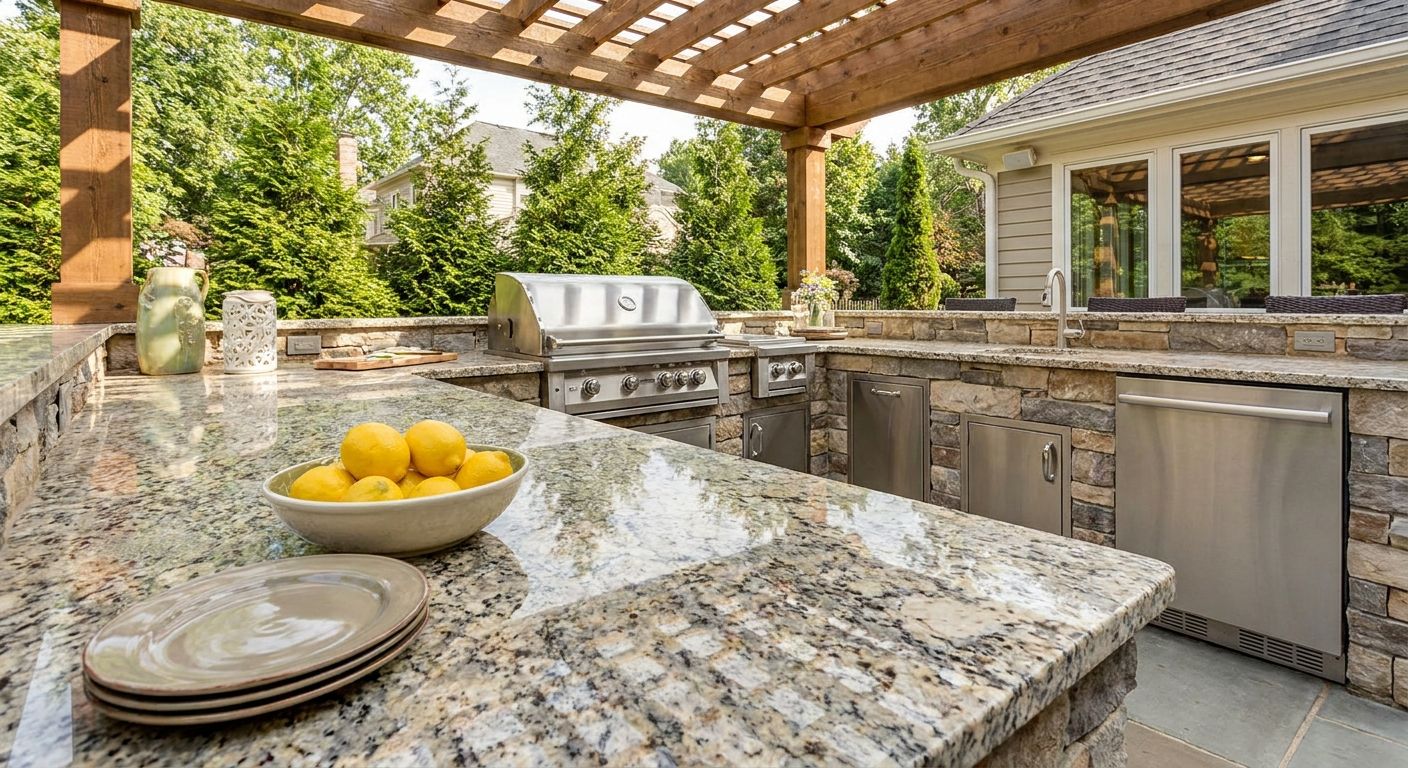
New England outdoor kitchens take a beating from freeze-thaw cycles, road salt overspray, and grill heat that indoor countertops never face — this guide breaks down which granite countertops for outdoor kitchens actually hold up and which ones look great in the showroom and fail by year three.
- Dense dark granites like Absolute Black or Baltic Brown handle New England winters best — Buy for full-exposure outdoor kitchens.
- Polished finishes glare in direct sun and show water spots fast — Consider honed or leathered instead.
- Granite countertops for outdoor kitchens need a penetrating sealer reapplied yearly, not the five-year indoor schedule.
- Light, porous granite slabs stain from grill grease and freeze-crack faster — Skip them for anything uncovered.
- Soares Stone fabricates and installs outdoor-rated granite and quartzite across New England, with edge and seam details built for exterior seasons.
Why this matters
An outdoor kitchen in New England lives through humid summers, salt-laced coastal air, and a winter freeze-thaw pattern that will find every hairline crack in a slab. Indoor-grade advice about granite doesn't transfer outside — a countertop rated fine for a kitchen island can spall or delaminate at a seam after two winters uncovered.
Granite is still the right material for most outdoor builds in 2026 because it's naturally low-porosity, heat-tolerant near grill stations, and doesn't need the resin-based binders that some engineered surfaces use — binders that break down under UV and freeze cycles. The catch is picking the right slab density, finish, and edge detail for the specific site, not just the right material family.
Who this is for
This guide is for New England homeowners planning or upgrading an outdoor kitchen — a grill island, a bar counter, or a full cook station — who want a surface that survives winter without cracking, staining, or needing replacement inside five years. If the space is fully covered by a pergola or roof year-round, some of these constraints loosen. If it's exposed to open sky and snow load, they don't.
What to look for in granite countertops for outdoor kitchens
Low porosity and absorption rate
Dense granite absorbs less water into the stone body, which matters directly for freeze-thaw survival — water that gets into micro-fissures and freezes is what cracks slabs over a New England winter. Granites with published absorption rates under 0.4% are the baseline to ask a fabricator for before signing off on a slab.
Sealant compatibility and reseal schedule
Outdoor granite countertops need a penetrating sealer reapplied annually, not the three-to-five-year indoor cycle, because sun, rain, and snowmelt strip sealer faster outside. Ask what sealer the fabricator uses and whether it's rated for exterior UV exposure — some indoor sealants yellow or fail outdoors within a single season.
Finish type: polished vs. honed vs. leathered
Polished granite throws glare in direct sun and shows water spots and fingerprints on a bar top used for drinks and food prep. Honed and leathered finishes diffuse light and hide minor etching, which makes them the more practical choice for uncovered outdoor kitchens even though polished remains the classic look.
Edge profile and overhang for outdoor use
Eased or bullnose edges shed water better than sharp square edges, which can trap moisture at the corner and accelerate freeze damage over multiple winters. Overhangs also need support brackets sized for New England snow load if the counter cantilevers over a bar or seating area.
Seam placement and adhesive rating
Every seam is a weak point outdoors, so seam count and placement matter more here than on an indoor island. Confirm the adhesive used at seams is exterior-rated — some standard indoor epoxies aren't formulated to flex with the temperature swings a New England outdoor kitchen sees between July and January.
Color and pattern against the hardscape
Granite that reads well against brick, bluestone, or composite decking in daylight can look flat or mismatched under evening grill lighting. Pull a full slab sample outdoors at the actual install site before committing, not just a small chip indoors.
Plan your outdoor kitchen countertop
Get a free estimate for granite built for New England winters.
Top picks for outdoor granite
Dense dark granite (Absolute Black, Baltic Brown, Uba Tuba) — the safe pick. These slabs run at or below 0.4% water absorption and hide grill soot and grease better than lighter stones. Verdict: Buy for any fully exposed grill island or bar top.
Leathered-finish granite — the wildcard. The textured surface diffuses glare and masks minor scratching from outdoor use, though it collects more dust between cleanings than a honed slab. Verdict: Consider for covered patios and shaded cook stations.
Exotic granite (Blue Pearl, Bianco Antico) — the showpiece. These patterns carry a striking look for a bar counter but cost more per square foot and show water spotting more visibly on lighter backgrounds. Verdict: Consider for a visible entertaining bar, Skip for a full uncovered cook station where staining risk is higher.
Polished granite — the classic finish. It looks sharp in photos and on a covered patio, but direct summer sun turns the surface into a mirror that's hard to work on and shows every water ring. Verdict: Skip for uncovered kitchens, Consider if the space sits under a permanent roof.
Quartzite as the granite alternative — the upgrade path. Quartzite runs harder than granite on the Mohs scale and resists etching from acidic marinades and citrus better than most granites. Soares Stone's guide to quartzite countertops for outdoor kitchens covers the tradeoffs if budget allows the step up. Verdict: Consider for households prioritizing scratch and etch resistance over granite's lower cost.
What to avoid
- Light, high-porosity granite without a tested seal — it looks premium in a showroom but stains from grease and salt spray faster than dense stone.
- Standard indoor edge profiles on an uncovered bar — square edges trap water at the corner and crack first after repeated freezes.
- Undersized overhangs without bracket support — New England snow load will stress an unsupported cantilever within a few winters, not decades.
Verdict comparison
| Option | Absorption Risk | Finish for Sun | Best Use | Verdict |
|---|---|---|---|---|
| Dense dark granite | Low | Honed or leathered | Uncovered grill island | Buy |
| Leathered granite | Low-moderate | Diffuses glare | Covered patio | Consider |
| Exotic light granite | Moderate | Shows spotting | Visible bar top | Consider/Skip |
| Polished granite | Low | Poor in direct sun | Covered kitchens only | Skip (uncovered) |
| Quartzite | Very low | Excellent | Full exposure, high use | Consider |
For homeowners weighing granite against quartzite more broadly, the comparison in how to choose between quartz and quartzite countertops covers indoor use cases side by side.
FAQ
What's the best granite for outdoor kitchens in New England?
Dense, dark granites like Absolute Black or Baltic Brown perform best because they run under 0.4% water absorption, which limits freeze-thaw cracking through New England winters. Lighter, more porous granites carry higher staining and cracking risk in the same conditions.
Is granite better than quartzite for outdoor kitchens?
Quartzite scores harder on the Mohs scale and resists etching from acidic foods better than granite, making it the upgrade pick for heavy-use outdoor cook stations. Granite remains the more budget-friendly option and still performs well outdoors when the right density and finish are chosen.
Does granite crack in cold weather?
Dense granite with low water absorption resists freeze-thaw cracking, but porous slabs or ones with poorly sealed seams can crack after repeated winters of moisture getting into micro-fissures and freezing. Annual resealing lowers that risk significantly.
How often do outdoor granite countertops need to be sealed?
Outdoor granite needs resealing about once a year, compared to every three to five years for the same stone indoors, because sun, rain, and snowmelt strip sealer faster outside. Skipping a season increases staining and moisture absorption risk.
Can I use polished granite on an outdoor kitchen counter?
Polished granite works fine on a covered patio but glares badly in direct sun and shows water spots more visibly than honed or leathered finishes. For fully exposed cook stations, a honed or leathered finish is the more practical choice.
What edge profile is best for outdoor granite countertops?
Eased or bullnose edges shed water better than square edges, which trap moisture at the corner and accelerate freeze damage over time. This matters more outdoors than on an indoor island because of repeated winter exposure.
Does grill heat damage granite countertops?
Granite tolerates high heat well and won't scorch from typical grill proximity, unlike some resin-based engineered surfaces. Direct, sustained contact with a hot pan can still cause thermal shock at a seam, so leaving clearance around the grill is worth building into the layout.
How much does granite cost for an outdoor kitchen?
Pricing varies by slab selection, edge detail, and site conditions, so getting a site-specific estimate is the accurate way to budget rather than relying on generic per-square-foot averages. A fabricator can price the exact slab and layout during a free estimate.
One last thing
The detail most homeowners skip is asking what adhesive gets used at the seams — an exterior-rated adhesive that flexes with New England's temperature swings between a July grill session and a January freeze is what actually keeps a granite countertop for an outdoor kitchen intact past the five-year mark, not just the slab choice itself.