A powder room countertop is maybe 4 to 6 square feet, but it gets more close-up scrutiny than any surface in the house — this guide breaks down which quartz vanity tops for powder rooms actually hold up to that scrutiny and which ones just look good in a showroom.
- Solid white or cream quartz is the safe pick for quartz vanity tops for powder rooms in 2026 — buy it if you're unsure.
- Bold veined quartz (Calacatta-style) is the statement pick for a small, high-visibility room — consider it if the rest of the room is quiet.
- Dark quartz shows water spots faster in a tight powder room and needs a matte or leathered finish to hide fingerprints — consider, don't default.
- Engineered quartz never needs sealing, unlike granite or marble vanity tops — a real maintenance win in a room nobody remembers to maintain.
Why this matters
A powder room isn't a working surface — nobody chops vegetables on it. What it does get is constant hand contact, splashed water, hairspray overspray, and a spotlight from a pendant fixture two feet away. That combination punishes the wrong material choice faster than a kitchen island ever would, because every flaw is at eye level in a room with no distractions.
Quartz vanity tops for powder rooms solve most of that problem out of the box: no sealing, no porosity, consistent pattern from a factory slab. The mistake homeowners make is picking the same slab logic they'd use for a kitchen island — big movement, bold veining, a slab that needs 40 square feet to read properly — and cramming it into a 5-square-foot top where the pattern gets chopped off mid-vein.
Who this is for
This guide is for a homeowner finishing a powder room renovation or replacing a builder-grade top, working with a footprint under 30 inches wide, who wants a surface that looks intentional rather than leftover. If you're also redoing a full kitchen, start with the broader Soares Stone project scope first — a powder room vanity is a much smaller decision than an island, and it's worth locking in slab and edge choices after the bigger room is settled, not before.
What to look for in quartz vanity tops for powder rooms
Pattern scale relative to the top
A 24-inch vanity top only shows about 4 square feet of stone. Big-movement veining designed for a kitchen island gets cut off awkwardly at that scale, and you end up with a random gray blob instead of a vein. Solid colors or fine, tight-grain patterns read cleaner in small footprints.
Edge profile for a tight sink cutout
Most powder room vanities pair with an undermount or vessel sink in a bowl smaller than a kitchen sink, which means the edge profile is visible from more angles. A simple eased or bullnose edge holds up better visually than an ornate ogee on a top this small — the ornate edge just looks busy next to a small basin.
Stain and etch resistance
Hairspray, perfume, and hand soap residue sit on a powder room top daily. Quartz resists etching from acidic splashes in a way that marble and some granites don't, which matters in a room where nobody's wiping down the counter after every guest.
Slab thickness and support at the sink cutout
A sink cutout removes material right where the top needs strength. 3cm quartz handles a tight cutout with less risk of hairline cracking near the drain hole than 2cm does, especially on a narrower vanity where there's less stone on either side of the bowl.
Sheen level under vanity lighting
Polished quartz throws glare under a bright vanity mirror light, which shows every water spot and fingerprint. A honed or leathered finish diffuses that glare and hides daily use better — a detail that matters more in a powder room than almost anywhere else in the house.
Cost per square foot at small scale
Because a powder room top is so small, the material cost difference between a mid-tier and premium quartz color is often a few hundred dollars total, not the thousands it would be on an island. This is the one room in the house where it makes sense to spend up for the pattern you actually want.
Top picks for quartz vanity tops for powder rooms
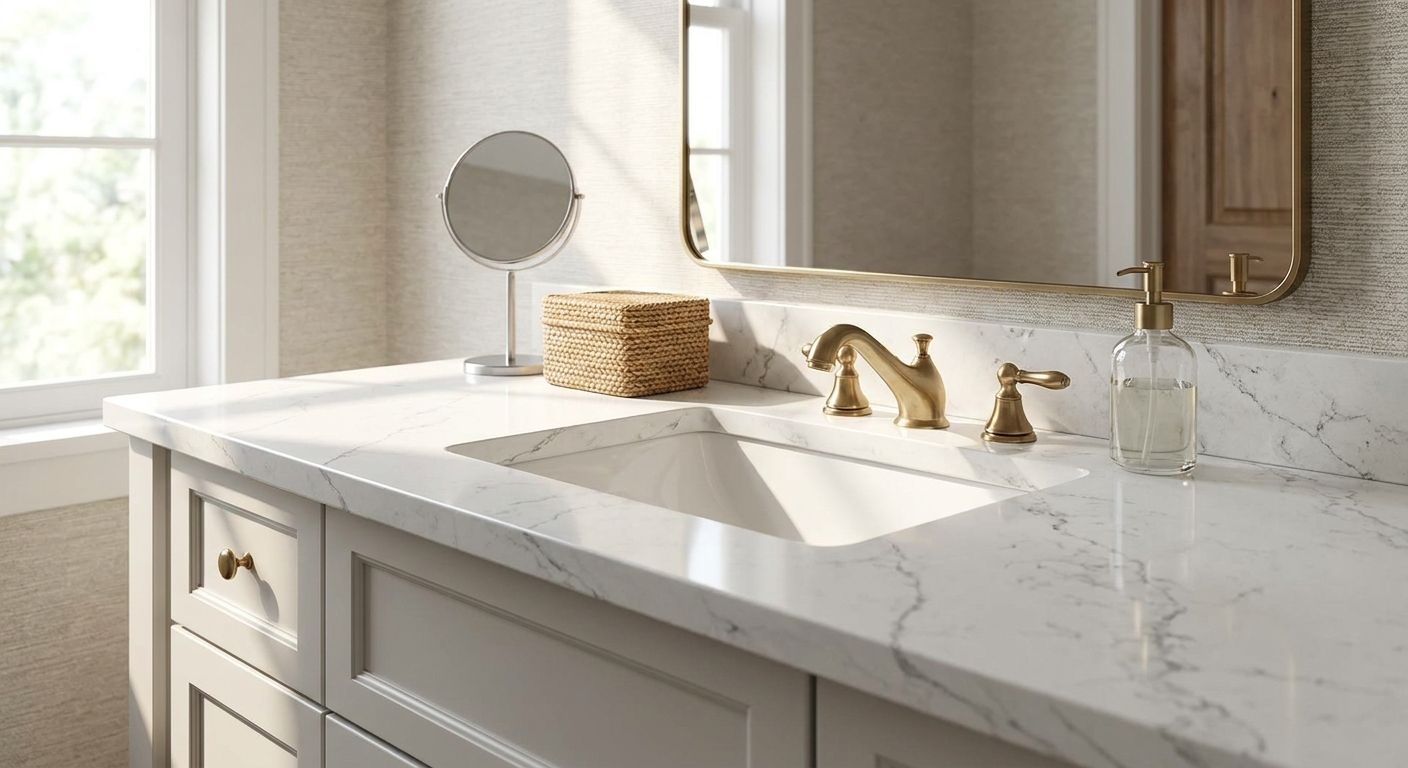
Solid white or cream quartz — the safe pick. Zero pattern to misalign, zero risk of an awkward vein cut. A 3cm slab in a warm white reads clean under any lighting and matches almost any vanity cabinet color. If you're deciding between this and a natural stone alternative, the how to choose between quartz and quartzite countertops breakdown covers the durability tradeoff in more detail. Buy.
Bold veined quartz — the statement pick. A Calacatta-style slab with gold or gray veining turns a powder room into the most memorable room on the tour, but only works if the vanity cabinet and walls stay simple. Order the slab in person and have the fabricator lay out the cutout before cutting — a 24-inch top only gets one shot at a good vein placement. Consider if the rest of the room is quiet; skip if the wallpaper is already busy.
Dark quartz (charcoal or black) — the dramatic pick. Dramatic against a white pedestal sink, but polished dark quartz shows water spots and fingerprints faster than any lighter color in a room with constant hand contact. A leathered or matte finish solves most of that. Homeowners torn between dark quartz and a natural dark granite should compare against granite countertops for bathroom vanities before committing, since granite in dark colors carries different sealing needs. Consider, and specify a matte finish — skip the high-polish version for daily-use guest bathrooms.
Textured or leathered quartz — the wildcard. A leathered finish adds tactile grip and hides fingerprints almost entirely, and it reads as a deliberate design choice rather than a budget one. It costs more per square foot than a standard polish, but on a top this small the total dollar difference stays modest. Homeowners set on natural veining instead of engineered material should look at marble countertops for bathroom vanities as the alternative, understanding marble needs periodic sealing that quartz doesn't. Buy if the guest bathroom gets heavy daily traffic.
Get a quote on your powder room top
Soares Stone fabricates and installs quartz vanity tops sized for small footprints.
What to avoid
- Kitchen-scale slab remnants cut down to size. A leftover piece from a kitchen island job often has veining that was never designed to be cropped to 24 inches, and it shows.
- High-polish dark colors under a bright vanity light. They look striking in the showroom and show every water spot within a week of daily use at home.
- Ornate edge profiles paired with a small vessel sink. The edge competes with the sink shape instead of framing it, and on a narrow top there's barely enough surface to show the edge detail properly anyway.
Verdict comparison
| Pick | Pattern risk | Maintenance | Best finish | Verdict |
|---|---|---|---|---|
| Solid white/cream quartz | Very low | Minimal | Polished or honed | Buy |
| Bold veined quartz | Moderate | Minimal | Polished | Consider |
| Dark quartz | Low | Higher (shows spots) | Matte/leathered | Consider |
| Textured/leathered quartz | Low | Very low | Leathered | Buy |
FAQ
What's the best quartz color for a powder room vanity top?
Solid white or cream quartz is the safest choice for a powder room vanity top because it has no pattern to misalign on a small footprint. Bold veined quartz works too, but only if the fabricator plans the vein placement before cutting the slab.
Is quartz better than granite for a powder room vanity?
Quartz needs no sealing and resists etching from acidic splashes better than most granite, which makes it lower-maintenance for a guest bathroom. Granite still works well and offers more natural pattern variation if that's the look you want.
How much does a quartz vanity top cost for a powder room in 2026?
Because a powder room top is only 4 to 6 square feet, total material cost stays low even when choosing a premium color, unlike a full kitchen island. Get a project-specific quote since pricing depends on slab selection and edge profile.
Do quartz vanity tops need sealing?
No — engineered quartz is non-porous and never needs sealing, unlike marble or granite vanity tops. This is one of the biggest maintenance advantages of quartz in a bathroom nobody remembers to maintain regularly.
What thickness is best for a powder room vanity top?
3cm quartz holds up better around a tight sink cutout than 2cm, especially on a narrow vanity with limited stone on either side of the bowl. 2cm can still work with proper support underneath.
Does quartz scratch easily on a bathroom vanity?
Quartz rates around 7 on the Mohs hardness scale, which makes it more scratch-resistant than most bathroom accessories that touch it daily. It won't scratch from normal use like hairbrushes, jewelry, or toiletry bottles.
Can I use a leftover kitchen slab for a powder room top?
You can, but a slab cut for a large kitchen island often has veining that reads as random and disconnected once cropped to a 24-inch vanity top. A dedicated small slab or remnant chosen specifically for that pattern scale looks more intentional.
What edge profile works best for a small vanity top?
A simple eased or bullnose edge suits most powder room vanities better than an ornate profile, since the small surface area makes decorative edges look busy next to a compact sink. Save ornate edges for larger surfaces where there's room for the detail to read properly.
One last thing
The detail most homeowners skip: ask for the sink cutout template before the slab gets cut, not after. On a top this small, moving the cutout even an inch can shift a vein pattern from centered to lopsided, and there's no way to fix it once the stone is cut in 2026 — or any year.