Marble backsplashes turn a kitchen remodel from "nice" into the kind of room people photograph. This guide breaks down what actually matters when you're picking marble for a backsplash in 2026 — not just what looks good in a showroom.
- Full-height Carrara slab backsplashes are the safe, resale-friendly pick for 2026 kitchen remodels — buy it.
- Calacatta gold honed marble is the statement wall for open-concept kitchens but needs sealing twice a year.
- Skip polished marble directly behind a range — etching from acidic splatter shows within months.
- Bookmatched slab backsplashes cost more per square foot but eliminate grout lines entirely.
Why this matters
A backsplash is the one surface in your kitchen you look at every single day, more than the countertop, more than the cabinets. Marble reads as a premium material because it is one — natural veining, real depth, no two slabs identical. But marble is also soft (3 to 4 on the Mohs hardness scale) and porous, which means the wrong install decision in 2026 turns into a maintenance headache in 2027. Get the material, finish, and placement right the first time and it becomes the room's focal point for decades. Get it wrong and you're staring at etch marks behind the stove by spring.
Soares Stone fabricates and installs custom marble surfaces for New England kitchens, and the questions homeowners ask before committing are almost always the same four or five. This guide answers them directly.
Who this is for
This guide is for homeowners planning a kitchen remodel who've already decided they want the look of marble but haven't settled on which application, finish, or layout fits their actual cooking habits. If you cook daily with acidic ingredients — tomato sauce, citrus, wine — pay close attention to the finish section below. If your kitchen is more entertaining space than working kitchen, the statement-slab picks further down apply directly to you.
What to look for in marble backsplashes for kitchen remodels
Veining pattern and slab selection
Marble is sold by the slab, not the swatch, and no two slabs veining the same way. Ask to see the actual slab your backsplash will be cut from before fabrication, not a sample chip. Veining direction matters most around a range hood or window, where a bold vein running the wrong way draws the eye off-center.
Polished vs. honed finish
Polished marble shows more depth and reflects light, but it also shows etching faster — acidic splashes dull the shine within weeks near a stove. Honed (matte) marble hides etching almost completely because there's no shine to disrupt, making it the more forgiving choice for a working kitchen in 2026.
Slab thickness
Marble backsplashes typically come in 2cm or 3cm thickness. Thinner 2cm slabs cost less and work fine for a standard backsplash height, but 3cm gives a heavier, more substantial edge when the backsplash runs full height to the cabinets.
Sealing and maintenance commitment
Marble needs resealing roughly every 6 to 12 months depending on kitchen use, more often in a heavily cooked-in kitchen. If you're not willing to reseal on that schedule, factor that into your finish choice now, not after installation.
Backsplash height
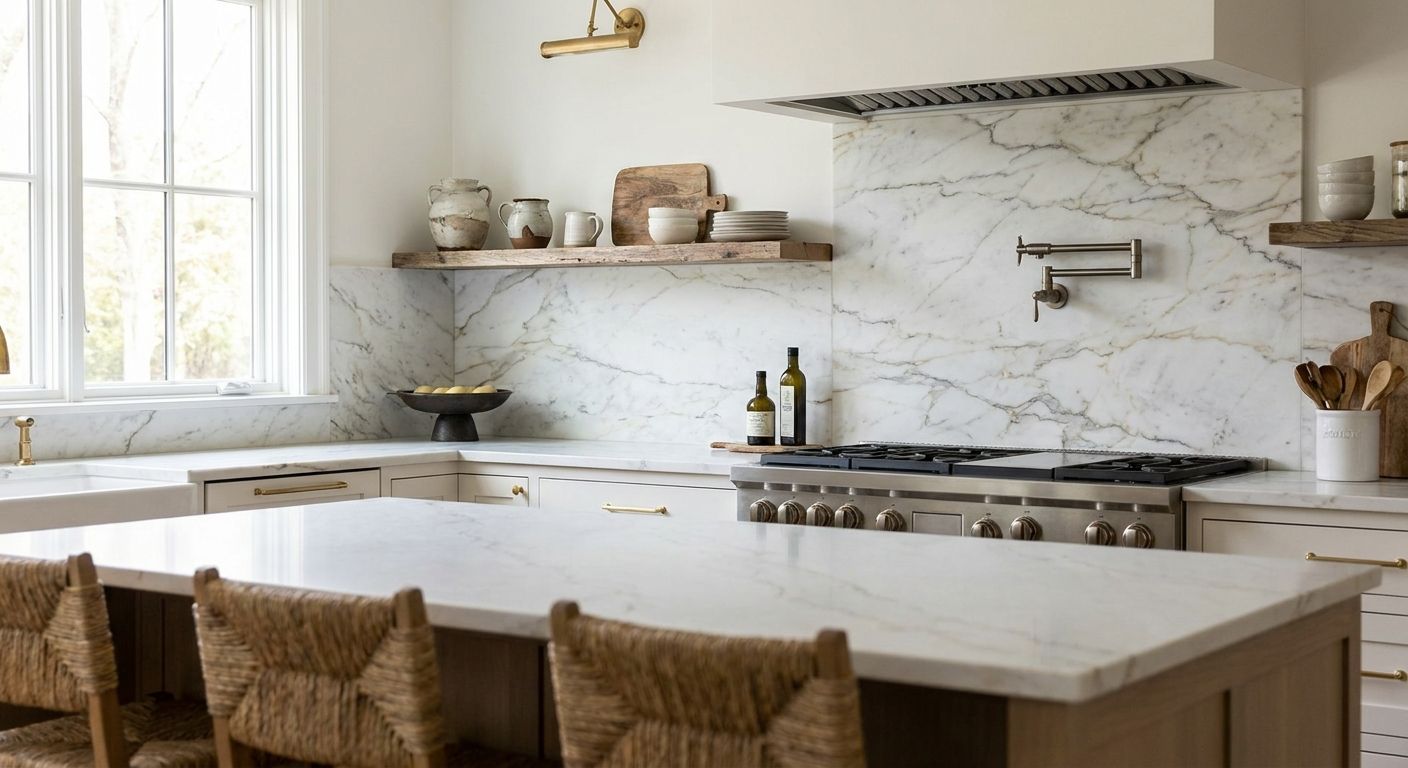
A standard backsplash runs about 4 inches; a full-height backsplash extends 18 to 24 inches up to the underside of the upper cabinets. Full-height marble creates the dramatic, uninterrupted look most 2026 remodel photos show, but it costs more per square foot in slab material.
Match to your countertop material
A marble backsplash doesn't require a marble countertop. Plenty of kitchens pair a marble backsplash with quartz or granite counters for durability where knives and heat matter most, saving the marble for the wall where it only has to look good. If you're weighing marble against quartz or quartzite for the counters themselves, the quartz vs quartzite comparison breaks down where each material holds up.
Top picks for marble backsplashes in 2026
The safe pick: full-height Carrara slab
Carrara marble's soft gray veining on a white ground is the most requested backsplash marble for a reason — it pairs with almost any cabinet color. One slab installed full-height eliminates seams behind the range, and the subtle veining hides minor water spots better than a bolder stone. Verdict: Buy if you want a backsplash that won't fight your next cabinet refresh.
The statement piece: honed Calacatta gold
Calacatta's thicker gold-and-gray veining reads as a focal wall on its own, especially behind an open shelf or floating range hood. Honed finish keeps the drama without the etching risk polished Calacatta carries near cooking heat. Verdict: Buy for open-concept kitchens where the backsplash is visible from the living space.
The budget-conscious pick: marble subway tile
Subway tile in marble gets you the material at a lower per-square-foot cost than slab, with the tradeoff of visible grout lines that need periodic resealing along with the stone itself. It's a reasonable entry point if slab pricing doesn't fit the remodel budget. Verdict: Consider if cost is the deciding factor and you're comfortable maintaining grout lines.
The wildcard: bookmatched slab panels
Bookmatching mirrors two slabs cut from the same block so the veining forms a symmetrical pattern across the backsplash — dramatic, but it roughly doubles the slab material needed since half of each cut slab becomes the mirror panel. Verdict: Consider only if the wall behind your range or island is wide enough and unobstructed enough to show the pattern off; a broken-up wall with windows and outlets wastes the effect.
The one to skip for daily cooking: polished marble mosaic behind the range
Small polished marble mosaic tiles look striking in photos but multiply the grout surface area directly in the splatter zone of a stove. Etching and staining show up fastest here, and the tight grout lines are harder to reseal evenly. Verdict: Skip for the cooking zone; save mosaic marble for an accent strip elsewhere in the kitchen.
Plan your marble backsplash
Get a free estimate for your kitchen remodel from a New England fabricator.
What to avoid
- Unsealed marble directly behind the range. It looks identical to sealed marble on install day and completely different six months later once acidic splatter starts etching the surface.
- Cultured or engineered "marble-look" panels sold as the real thing. They photograph fine online but lack the veining depth and cool touch of quarried marble, and they don't hold up to the same maintenance routine — because they're not the same material.
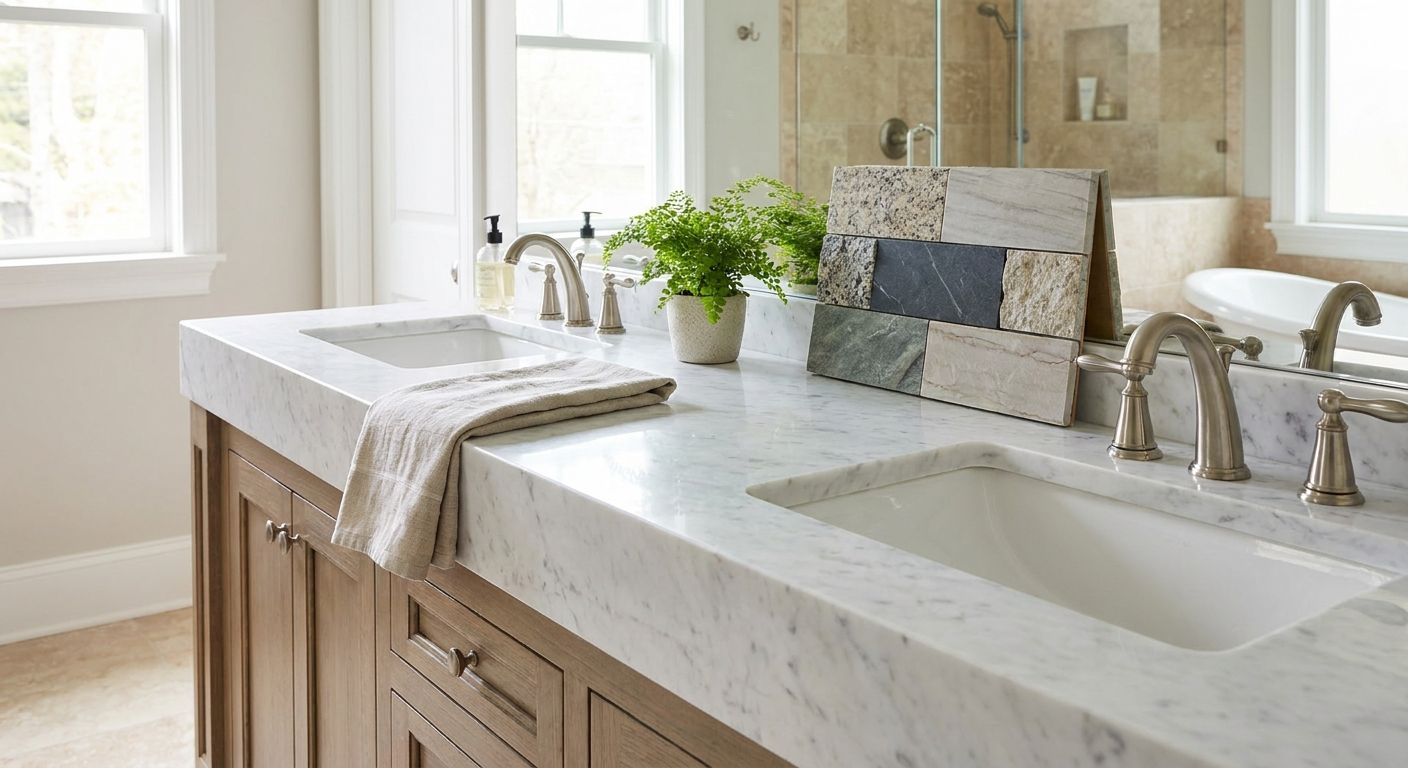
- Mismatched veining direction between backsplash and island or vanity. If you're carrying the marble look into a bathroom vanity or island elsewhere in the home, mismatched veining direction between rooms reads as an afterthought rather than a design choice. If you're extending the marble look to a bathroom vanity, pull the slab selection at the same time as the backsplash.
Verdict comparison table
| Style | Best for | Maintenance | Verdict |
|---|---|---|---|
| Full-height Carrara slab | Most kitchen remodels | Reseal every 6-12 months | Buy |
| Honed Calacatta gold | Open-concept, statement wall | Reseal every 6-12 months | Buy |
| Marble subway tile | Budget-conscious remodels | Reseal tile + grout | Consider |
| Bookmatched slab panels | Wide, unobstructed walls | Reseal every 6-12 months | Consider |
| Polished mosaic behind range | Accent walls away from cooking | Frequent resealing needed | Skip near range |
FAQ
What's the best marble for a kitchen backsplash in 2026?
Carrara marble is the most requested backsplash choice for 2026 remodels because its subtle gray veining pairs with nearly any cabinet color and hides minor wear better than bolder stones like Calacatta.
Is honed or polished marble better for a backsplash?
Honed marble hides etching from acidic splatter far better than polished marble because there's no shine to disrupt. Polished marble looks more dramatic but shows wear faster near a range.
How much does a marble backsplash cost compared to tile backsplash?
Slab marble backsplashes cost more per square foot than marble subway tile because of the larger continuous cut, but slab eliminates grout lines and the resealing that comes with them.
Does a marble backsplash need to match the countertop?
No. Many kitchens pair a marble backsplash with quartz or granite countertops, keeping the durable material on the counter and the marble look on the wall where it only needs to look good.
How often does a marble backsplash need to be sealed?
Marble backsplashes typically need resealing every 6 to 12 months depending on kitchen use, with heavily cooked-in kitchens needing it closer to the 6-month mark.
Can marble backsplashes go behind a gas range?
Yes, but honed marble handles the heat and splatter zone behind a range better than polished marble, and unsealed marble in that spot etches within months.
What's the standard height for a marble backsplash?
A standard backsplash runs about 4 inches, while a full-height backsplash extends 18 to 24 inches up to the underside of the upper cabinets for a more dramatic, seamless look.
Is bookmatched marble worth the extra cost?
Bookmatched marble is worth it on a wide, unobstructed wall where the mirrored veining pattern is fully visible, but it roughly doubles slab material use and loses its effect on a broken-up wall with windows or outlets.
One last thing
Most homeowners planning a 2026 remodel focus entirely on the backsplash slab and forget the edge detail where it meets the countertop — a mitered or bullnose edge there costs little extra but is the difference between a backsplash that looks fabricated as one piece and one that looks glued on afterward. Ask your fabricator to show that edge detail on the same slab sample you're already reviewing, before it's cut.