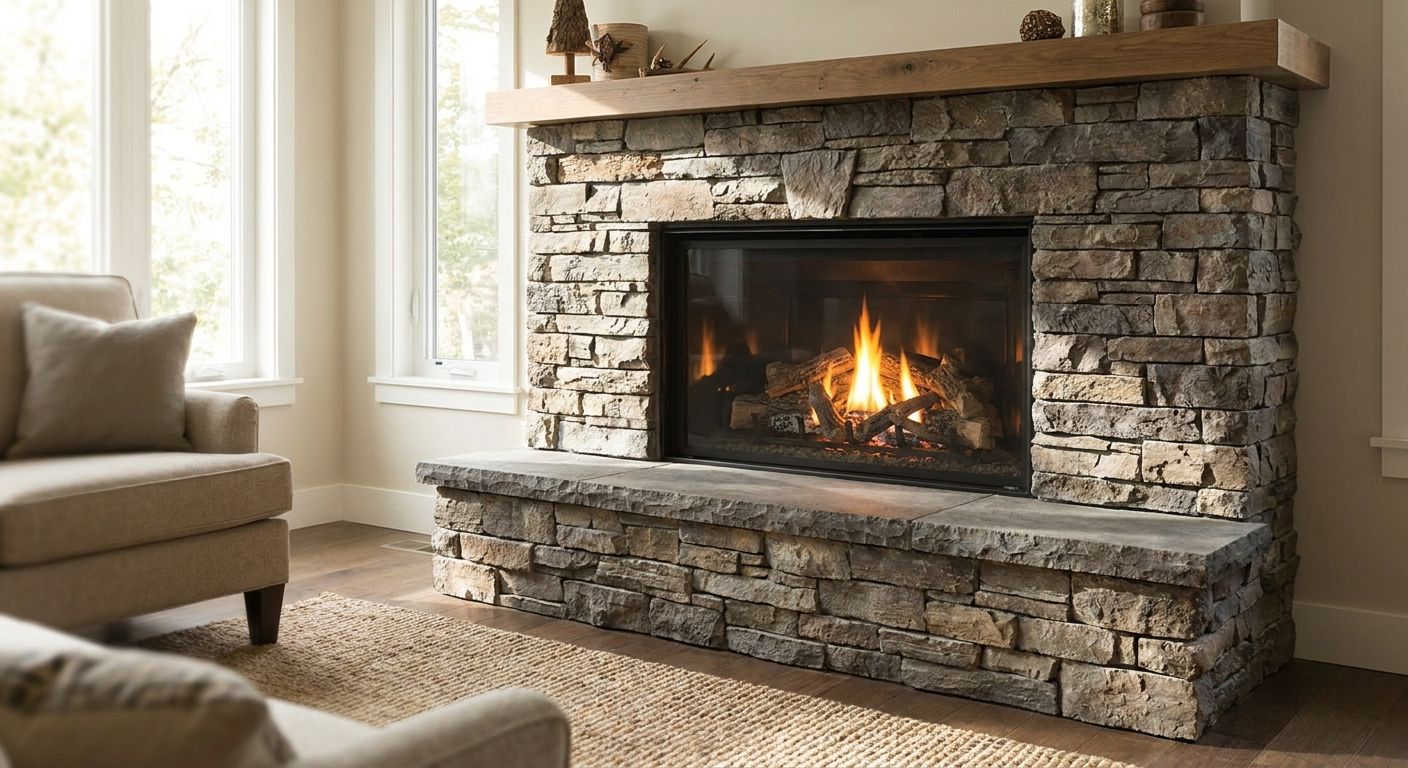
A gas fireplace runs hotter and longer than a wood-burning one, and the stone framing it has to handle that heat cycle for decades without cracking, staining, or looking cheap. Custom stone hearths for gas fireplaces solve that problem with marble, granite, or quartzite cut and fit to your firebox, your mantel height, and your room.
- Granite fireplace surrounds are the safe pick for gas inserts in 2026 — Mohs 6-6.5 hardness handles daily heat cycling with zero maintenance.
- Marble hearths look classic but need annual sealing and are softer at Mohs 3-4 — buy for formal rooms, not high-traffic family rooms.
- Skip engineered quartz near the firebox opening — resin binders start discoloring past 150°F, and gas inserts run hotter than that at the surface.
- Quartzite is the wildcard: Mohs 7 hardness, near-zero staining, and heat performance that already proves out on outdoor kitchen counters.
- Custom stone hearths for gas fireplaces run on 3cm slab standard — thinner stock flexes and cracks over a firebox opening.
Why this matters
Gas fireplaces cycle heat every time they run, and the stone touching that firebox opening takes the brunt of it for years, not just a season. Pick the wrong material and you get hairline cracks, cloudy discoloration around the opening, or a surround that looks dated the moment the next design trend rolls through. Soares Stone fabricates and installs custom hearths across New England, and the material decision at the front end determines whether the surround looks the same in 2036 as it did on install day.
Most homeowners get this decision wrong because they shop fireplace surrounds the same way they shop kitchen counters. A gas firebox opening is a different heat environment than a cooktop, and the stone selection criteria change accordingly.
Who this is for
This guide is for New England homeowners installing or replacing a gas fireplace insert and want a stone surround that survives daily heat cycling, meets manufacturer clearance specs, and matches the rest of the room. It applies whether you're finishing a new build's family room or ripping out a dated tile surround in a 1960s colonial.
What to look for in custom stone hearths for gas fireplaces
Heat tolerance of the material
Natural stone — marble, granite, quartzite — handles direct and radiant heat from a gas firebox without structural damage. Engineered quartz cannot make the same claim: its resin binder starts to discolor and can crack under sustained exposure above roughly 150°F, and gas insert surfaces routinely run hotter than that near the opening.
Slab thickness and structural support
A 3cm slab (about 1.25 inches) is the standard for fireplace surrounds because it spans the firebox opening without flexing. Thinner 2cm stock looks the same in a showroom sample but needs additional substrate backing over an opening, adding a failure point that isn't worth the savings.
Hearth extension and clearance to combustibles
Every gas fireplace insert ships with a manufacturer clearance spec for how far non-combustible material must extend from the firebox opening — check that document before ordering stone, not after. Local building code enforces the same clearance, and a fabricator who's installed dozens of these knows to template around it rather than discover it during install.
Color and veining scale for the room
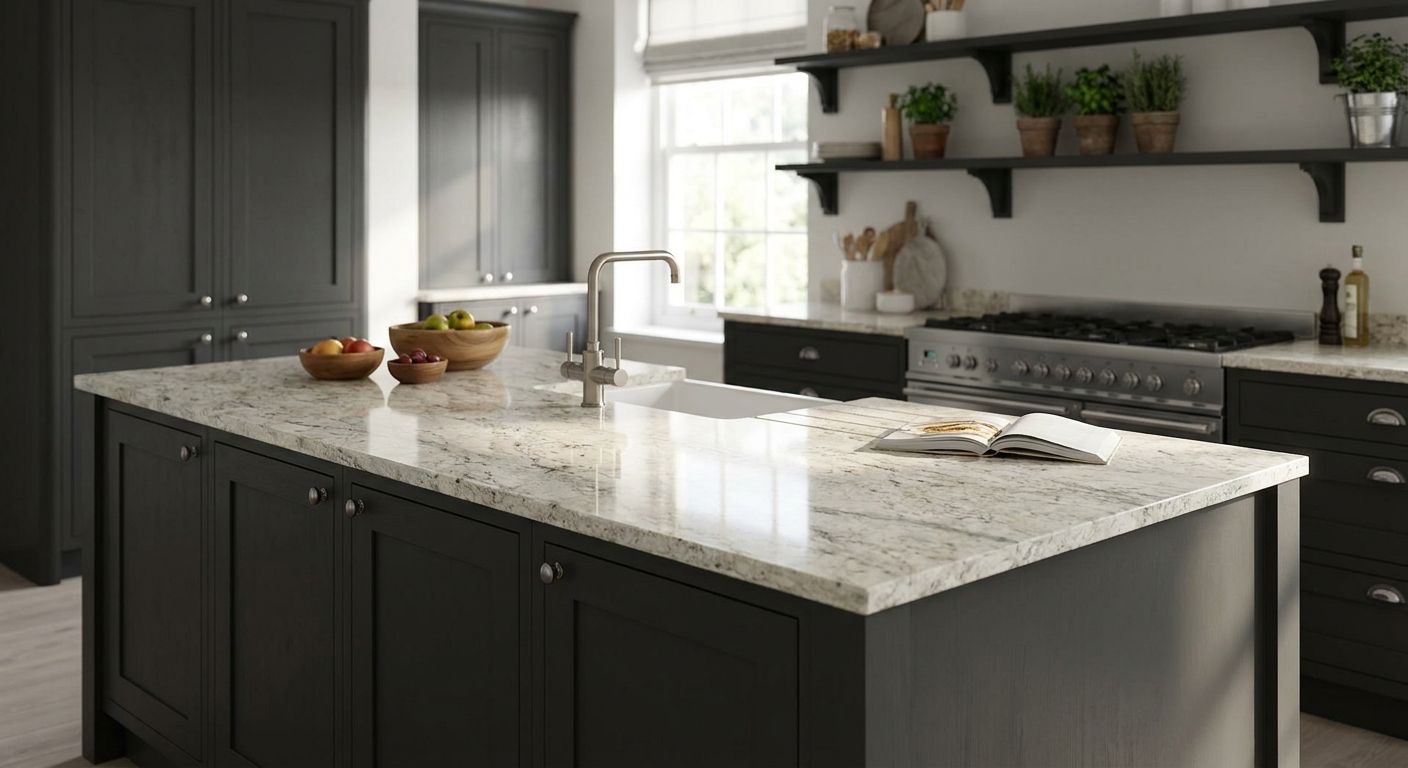
A hearth surround is a small canvas compared to a kitchen island, and large dramatic veining that reads beautifully across 9 feet of countertop can look chopped and busy on a 4-foot-wide surround. Tighter, more uniform patterns generally read better at hearth scale.
Maintenance and sealing needs
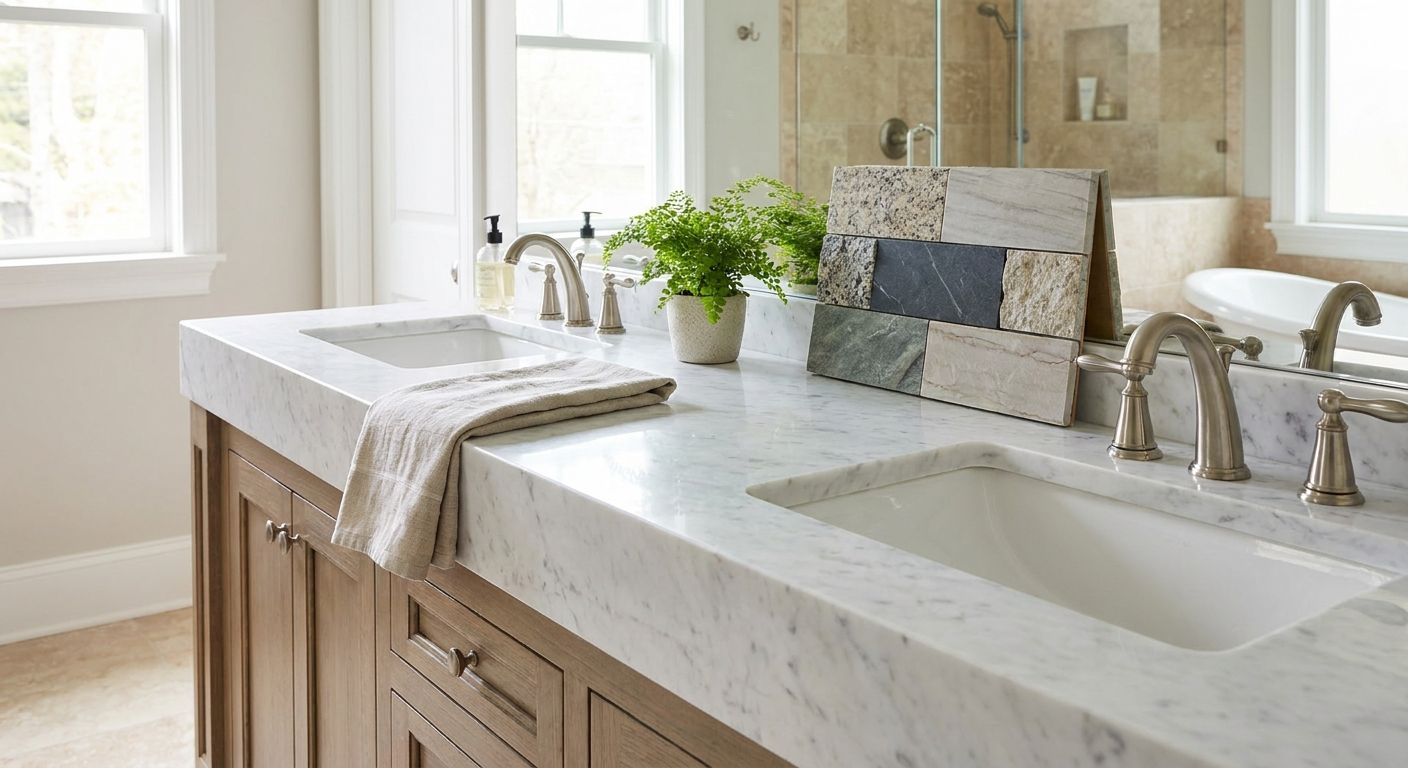
Marble needs sealing on a roughly annual schedule and etches if acidic cleaners touch it — rare near a fireplace, but ash and soot residue is mildly abrasive over time. Granite and quartzite need sealing far less often and shrug off routine cleaning with none of marble's etch risk.
Cost tier by material
Marble and granite fireplace surrounds typically sit at different price points depending on slab selection and edge profile, and quartzite generally commands a premium over granite for equivalent square footage. Get a firm quote against your actual firebox dimensions rather than budgeting off a per-square-foot average, since fabrication and template work — not raw slab cost — drives a large share of a hearth quote.
Top picks for custom stone hearths for gas fireplaces
Marble — the classic pick
Marble's soft white-and-gray veining is the look most people picture when they think "fireplace surround," and it's earned that reputation in formal living rooms and colonial-style homes across New England for a reason. At Mohs 3-4 hardness, it's the softest of the three natural stone options here, and it needs sealing on a regular schedule to resist staining from ash residue. Soares Stone's marble fireplace surrounds fit gas inserts and wood-look gas logs alike, cut to your firebox opening.
Verdict: Buy for formal rooms with low daily traffic where the classic look outweighs the sealing commitment.
Granite — the safe pick
Granite sits at Mohs 6-6.5, well above marble, and handles decades of gas insert heat cycling with essentially no maintenance beyond an occasional wipe-down and infrequent resealing. It comes in enough color and pattern variation to match nearly any New England home style, from farmhouse to contemporary. Soares Stone's granite fireplace surrounds for New England homes are the most requested hearth material on the fabrication schedule for exactly this reason — durability without a maintenance calendar.
Verdict: Buy for family rooms and any space that gets daily use near the firebox.
Quartzite — the wildcard
Quartzite is the hardest of the three at Mohs 7, harder than granite, and it resists staining and etching better than either marble or granite. It's not commonly marketed as a fireplace material, but the same durability that makes it a strong choice for weather-exposed applications — see Soares Stone's work with quartzite countertops for outdoor kitchens — translates directly to a firebox environment that cycles heat daily. It costs more than granite for equivalent square footage, and slab selection is more limited since fewer quarries produce true quartzite.
Verdict: Consider if you want granite's durability with marble's veining character and the budget supports it.
Get a custom hearth estimate
Send your firebox dimensions and get a fabrication quote for 2026 install slots.
What to avoid
- Engineered quartz surrounds. The resin binder that makes quartz nonporous is the same material that discolors and can crack near a firebox opening running hotter than 150°F. If you're torn between quartz and a natural stone for this application, Soares Stone's quartz vs. quartzite comparison guide breaks down exactly where each material belongs in a home — and a gas fireplace surround isn't quartz's lane.
- Undersized slab thickness. A 2cm slab quoted as a budget option over a firebox opening needs extra substrate support to avoid flexing — factor that into the real cost before you compare quotes.
- Oversized veining on a small surround. A dramatic bookmatched slab that looks incredible on a 10-foot island can look chopped and busy cut down to a 4-foot hearth face — ask to see the actual slab, not just a sample chip, before you commit.
Verdict comparison
| Material | Mohs Hardness | Maintenance | Best For | Verdict |
|---|---|---|---|---|
| Marble | 3-4 | Annual sealing | Formal, low-traffic rooms | Buy |
| Granite | 6-6.5 | Rare resealing | Daily-use family rooms | Buy |
| Quartzite | 7 | Minimal | High durability + veined look | Consider |
| Engineered quartz | 6-7 (surface) | Low, but heat-limited | Not recommended near firebox | Skip |
FAQ
What's the best stone for a gas fireplace hearth in 2026?
Granite is the safest all-around choice for a gas fireplace hearth in 2026 because it handles daily heat cycling at Mohs 6-6.5 hardness with almost no maintenance. Marble and quartzite are strong alternatives depending on whether you prioritize classic veining or maximum durability.
Is granite or marble better for a fireplace surround?
Granite is more durable at Mohs 6-6.5 versus marble's Mohs 3-4, and needs sealing far less often. Marble wins on the classic white-veined look but requires more upkeep and is more prone to staining from ash residue near the firebox.
Can you put quartz around a gas fireplace?
Engineered quartz is not recommended directly around a gas fireplace firebox opening because its resin binder can discolor or crack above roughly 150°F. Natural stone — granite, marble, or quartzite — handles that heat without the risk.
How thick should a stone fireplace hearth be?
A 3cm slab, about 1.25 inches, is the standard thickness for a stone fireplace surround because it spans the firebox opening without flexing. Thinner 2cm slabs need extra substrate backing to hold up structurally.
Do stone fireplace hearths need sealing?
Marble hearths need sealing on roughly an annual schedule to resist staining, while granite and quartzite need it far less often. Sealing frequency depends on the specific stone's porosity, so ask your fabricator for a schedule at install.
How much clearance does a gas fireplace need from stone?
Clearance to combustible materials is set by the specific gas insert manufacturer's spec sheet, and local building code enforces the same requirement. Check that document before ordering stone so the surround templates correctly around it.
Does quartzite crack from heat near a fireplace?
Quartzite is the hardest natural stone commonly used for hearths at Mohs 7 and holds up well under sustained heat cycling. It's not a standard fireplace material yet, but its performance in heat-exposed applications like outdoor kitchen counters supports the same use case indoors.
What does a custom stone hearth cost in 2026?
Cost depends on the material chosen, slab selection, and the fabrication and template work specific to your firebox dimensions, which drives a large share of the quote beyond raw slab price. Get a firm quote against your actual measurements rather than budgeting off a generic per-square-foot number.
One last thing
Most of a custom hearth quote is template and fabrication labor, not raw slab material — which means going from a small surround to a full floor-to-mantel stone treatment often costs less incrementally than homeowners expect. If you're already replacing the surround in 2026, price out the full-height version before you settle for a small insert frame; the labor's already committed either way.