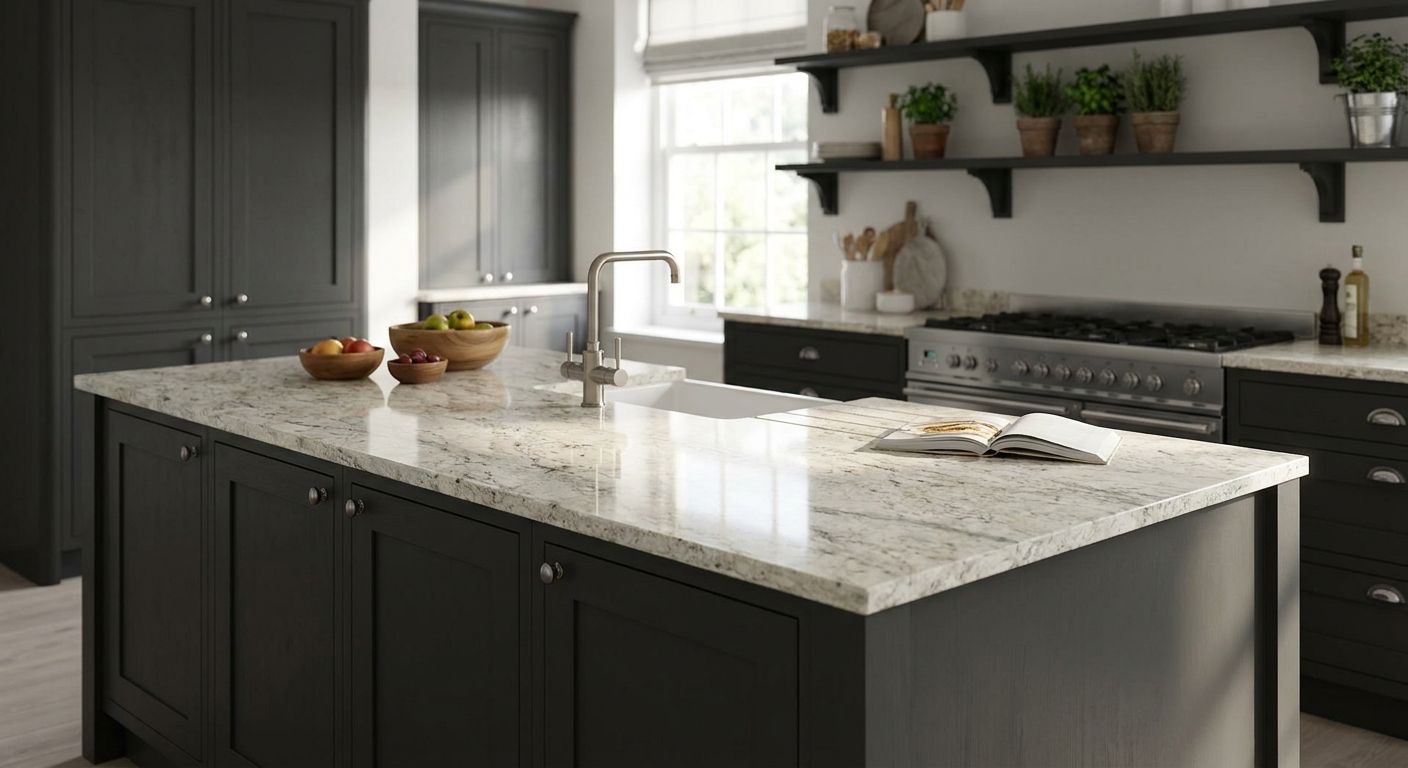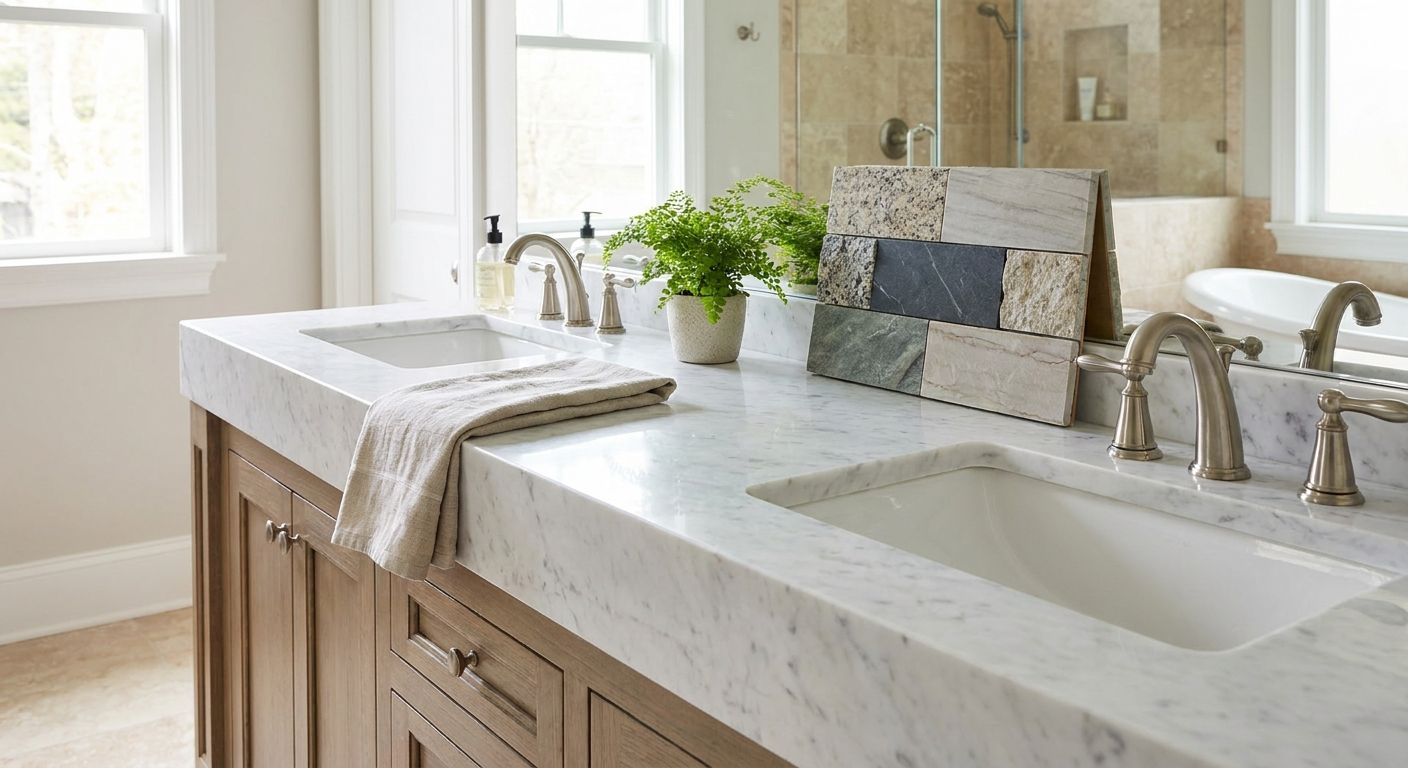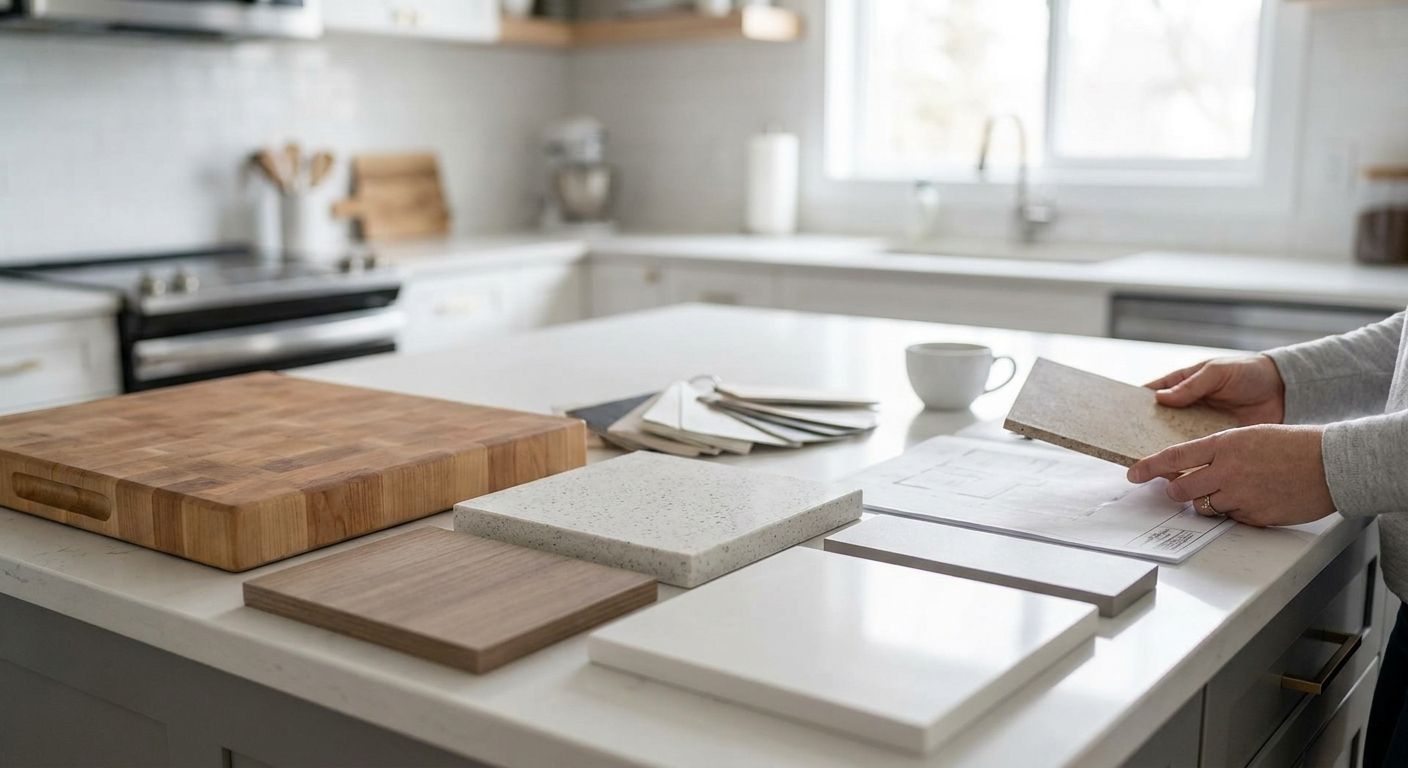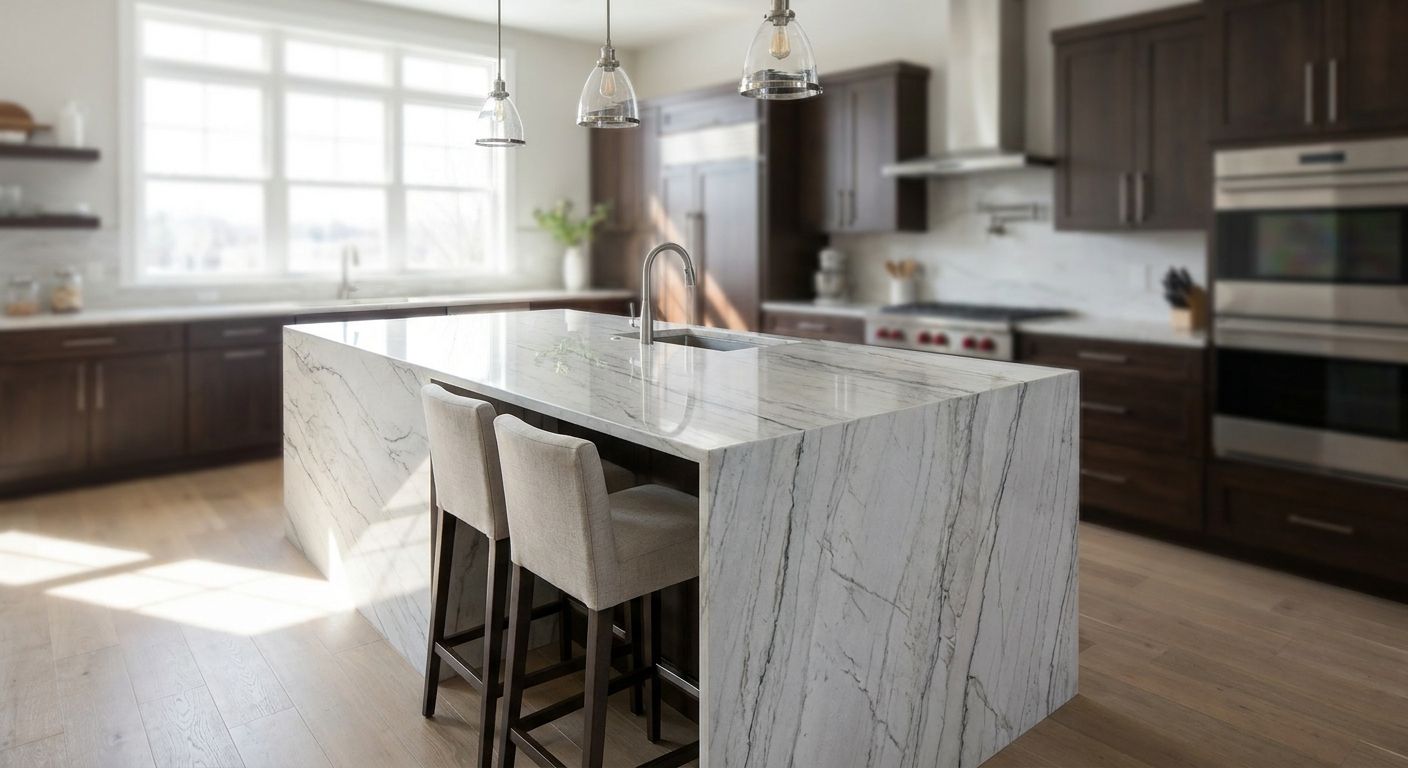
A quartzite waterfall island turns a kitchen island into a single sculpted block of stone, with the same slab wrapping over the top and running straight down both sides to the floor. Here's what actually holds up at the miter joint, which quartzite patterns are worth the extra slab, and where homeowners get burned.
- Taj Mahal Quartzite and Calacatta Macaubas are the safest quartzite waterfall islands for modern kitchens in 2026 -- buy them.
- Fusion Quartzite (Sea Pearl) is the wildcard: gorgeous single-slab but hard to match at the corner. Consider, don't commit blind.
- Waterfall legs need full-length slabs from the same block -- remnants and busy directional movement ruin the miter match.
- Quartzite runs a Mohs hardness of 7, so it resists scratches and heat better than marble at the same waterfall detail.
Why this matters
A waterfall edge is unforgiving. Any pattern mismatch, seam shadow, or color drift between the deck and the leg is at eye level, in the busiest room in the house, for as long as you own the kitchen. Standard countertop mistakes get hidden under appliances; waterfall mistakes get photographed.
Quartzite is also not one material -- it's a category with wide swings in hardness, porosity, and how consistently a quarry block cuts. What reads as "quartzite" on a slab yard tag can behave more like soft marble or more like granite. Getting the waterfall right in 2026 means picking a slab that both looks continuous across the miter and survives daily use as an island, not just a backsplash.
Who this is for
This guide is for homeowners planning a kitchen renovation who've already decided they want a full-height waterfall island and are choosing between quartzite slabs, not between quartzite and quartz in general. If you're still weighing quartz against quartzite as a material, how to choose between quartz and quartzite countertops is the better starting point. If you've made the quartzite call and now need to pick the slab and layout, keep reading.
What to look for in quartzite waterfall islands for modern kitchens
Vein and pattern continuity across the miter
The entire point of a waterfall is that the pattern appears to keep flowing from the countertop down the side. That only happens when the deck and the leg are book-matched or sequence-matched from the same block, cut in the correct order. A slab with strong linear veining, like Taj Mahal Quartzite, telegraphs any mismatch instantly -- a busy, directionless pattern hides seams better but sacrifices the visual effect people want a waterfall for in the first place.
Hardness and heat resistance for a high-traffic surface
Quartzite sits around 7 on the Mohs hardness scale, close to true granite and well above marble's 3 to 4. That matters more on a waterfall island than a standard counter because the vertical legs take daily contact from stools, kids, and dropped pans in a way a horizontal deck doesn't. A softer stone marketed as quartzite chips at the vertical corner first.
Slab yield for the vertical legs
A waterfall island doesn't need one slab -- it typically needs two full slabs plus a portion of a third to cover the deck and both legs without piecing. Standard quartzite slabs run roughly 120 by 65 inches, and a fabricator has to lay out the whole cut plan before anything is scored. Ask what the full-slab yield looks like before you fall for a slab photo online; the piece that looks stunning in a 4-by-8 sample can't always deliver two clean, matching legs.
Finish for how the kitchen actually gets used
Polished quartzite shows fingerprints and water spots on a vertical leg that gets touched constantly near a kitchen island countertop. A honed finish hides smudges better and is worth considering for the vertical panels even if you keep the deck polished -- a mixed finish on the same slab is a request your fabricator needs to hear before cutting, not after.
Structural support at the mitered corner
A 45-degree mitered corner has no natural strength of its own -- it relies on plywood substrate, corner bracing, and correct adhesive at glue-up. This is a fabrication and installation detail, not a slab-selection detail, but it decides whether that corner survives a decade of daily bumps or hairlines within two years.
Cost tier relative to the rest of the kitchen
Waterfall islands use roughly double the stone of a standard island plus extra fabrication time for the miter and template. Before you fall in love with a rare quartzite block, get a straight answer on what full-slab yield and labor add to the project relative to a granite countertops for kitchen islands approach, which delivers a similar look at a different cost tier.
Top picks for quartzite waterfall islands
Taj Mahal Quartzite -- the safe pick. Warm cream background with soft, linear veining that runs in one direction, which makes book-matching across a waterfall miter far more forgiving than busier stones. Mohs hardness of 7 holds up to daily island traffic in 2026 kitchens without the scratch concerns marble carries at the same detail. Buy if you want the waterfall look without gambling on a hard-to-match pattern.
Calacatta Macaubas -- the marble look-alike. Bright white field with bold gray and gold veining that mimics Calacatta marble but carries quartzite's 7 Mohs hardness instead of marble's 3 to 4. The bold veining demands a careful full-slab layout, but the payoff is a waterfall that reads as luxury marble and shrugs off daily wear. Buy for a modern kitchen built around a statement island.
White Macaubas -- the dramatic pick. Large-scale gray movement across a bright white base, best suited to islands where the waterfall is the only strong pattern in the room. Slab sizes run large, often near 130 by 65 inches, which helps yield but also means fewer blocks in the market carry consistent movement block to block. Consider it if your fabricator can show you the actual slab, not a catalog photo, before you commit.
Fusion Quartzite (Sea Pearl) -- the wildcard. Blue-gray background with visible quartz crystal glitter that looks spectacular under kitchen lighting but varies more slab to slab than any pick on this list. Matching two legs and a deck from the same block is harder here than with the others, and a mismatched Fusion waterfall is more noticeable than a mismatched Taj Mahal. Consider for a single-slab feature wall or backsplash pairing; Skip it if a tight waterfall match is non-negotiable.
Aspen White Quartzite -- the budget-conscious quartzite. Subtle cream and white movement with a quieter pattern than the Macaubas stones, which makes vein-matching across the miter more achievable for fabricators working with standard slab sizes. Less dramatic on Instagram, more forgiving in a working kitchen. Buy if durability and a clean install matter more to you than maximum visual drama.
Plan your waterfall island layout
Get a full-slab yield and fabrication estimate before you pick a quartzite.
What to avoid
- Remnant slabs for the waterfall legs. A remnant might be the right color at a glance, but it almost never comes from the same block as your deck slab, so the miter match fails under kitchen lighting.
- Busy, directional quartzite chosen for a subtle look. If the marketing photo shows heavy movement in one direction, the waterfall will show every inch of that movement doubled at the corner -- it either becomes the room's focal point or it looks accidental.
- Skipping the full-slab layout walkthrough. A fabricator who cuts before showing you exactly where the deck ends and each leg begins is guessing at the match, not planning it.
Verdict comparison
| Quartzite | Look | Mohs hardness | Best for | Verdict |
|---|---|---|---|---|
| Taj Mahal Quartzite | Cream, linear veining | 7 | Forgiving waterfall match | Buy |
| Calacatta Macaubas | White with bold veining | 7 | Marble look, modern kitchens | Buy |
| White Macaubas | Bold gray movement | 7 | Statement islands, large slabs | Consider |
| Fusion Quartzite (Sea Pearl) | Blue-gray with crystal glitter | 7 | Single-slab features | Consider / Skip |
| Aspen White Quartzite | Quiet cream movement | 7 | Budget-conscious durability | Buy |
FAQ
What is a quartzite waterfall island?
A quartzite waterfall island is a kitchen island where the same quartzite slab covers the countertop deck and wraps down both vertical sides to the floor, meeting at a mitered 45-degree corner. The effect only works when the deck and legs are cut from the same block so the pattern appears continuous.
Is quartzite better than quartz for a waterfall island?
Quartzite offers natural veining and a Mohs hardness around 7, giving it a distinct look with strong scratch and heat resistance, while engineered quartz offers more color consistency slab to slab. Neither is universally better -- it comes down to whether you want natural variation or predictable pattern matching.
How much quartzite do you need for a waterfall island?
Most waterfall islands need roughly two full slabs plus a portion of a third slab to cover the deck and both vertical legs without piecing. Standard quartzite slabs run around 120 by 65 inches, so your fabricator needs the full layout before cutting to confirm yield.
Can you do a waterfall edge with any quartzite slab?
No -- slabs with strong directional veining are far harder to match cleanly at the miter than slabs with quiet, uniform movement. A pattern that looks stunning as a single flat piece can look mismatched once it's split across a deck and two legs.
How thick should quartzite be for a waterfall island?
Waterfall islands typically use 3cm (roughly 1.25 inch) quartzite, which gives the vertical leg enough structural presence at the mitered corner without requiring lamination. Thinner slabs need extra support at the miter joint.
Does a waterfall island cost more than a standard island?
Yes -- a waterfall uses roughly double the stone of a standard island top plus additional template and fabrication time for the mitered corners. Get a project-specific estimate rather than assuming a flat multiplier, since slab yield varies by pattern.
Is the quartzite waterfall island trend still relevant in 2026?
Yes -- waterfall islands remain a defining feature of modern kitchen renovations in 2026, particularly paired with quiet-pattern quartzite that ages well against daily use. The trend has shifted toward more forgiving, less busy veining compared to a few years ago.
What's the difference between quartzite and marble for waterfall islands?
Quartzite runs around 7 on the Mohs hardness scale versus marble's 3 to 4, making quartzite more resistant to scratches and etching at the exposed vertical corner. Marble offers softer, more classic veining but needs more careful maintenance on a high-traffic island.
One last thing
The corner is what fails, not the field of the slab -- ask any fabricator to show you a mitered corner that's been in service for a few years before you sign off on a pattern, because that seam tells you more about long-term durability than any showroom sample.